AI Chatbot Pricing: What the Four Models Really Cost
Sublex Digital · 3 September 2026 · 13 min read
AI chatbot pricing is not really a question of which product is cheapest. It is a question of which billing model you are agreeing to, because four different models are in common use, and the same five hundred customer conversations can produce a bill of thirty dollars or four hundred depending only on which one you signed.
The headline price on a pricing page tells you almost nothing about this. What decides the bill is the unit being counted, what happens when you exceed it, and how many separate meters are running at once. This piece works through all four models, does the arithmetic at a realistic volume, and says plainly where each one wins, including the volumes where the model this site sells is the wrong choice.
Every price quoted here was read from that product's own published pricing page on 1 September 2026, with the billing toggle checked in both states so the monthly and the annual figure are each reported as what they are.
The four AI chatbot pricing models
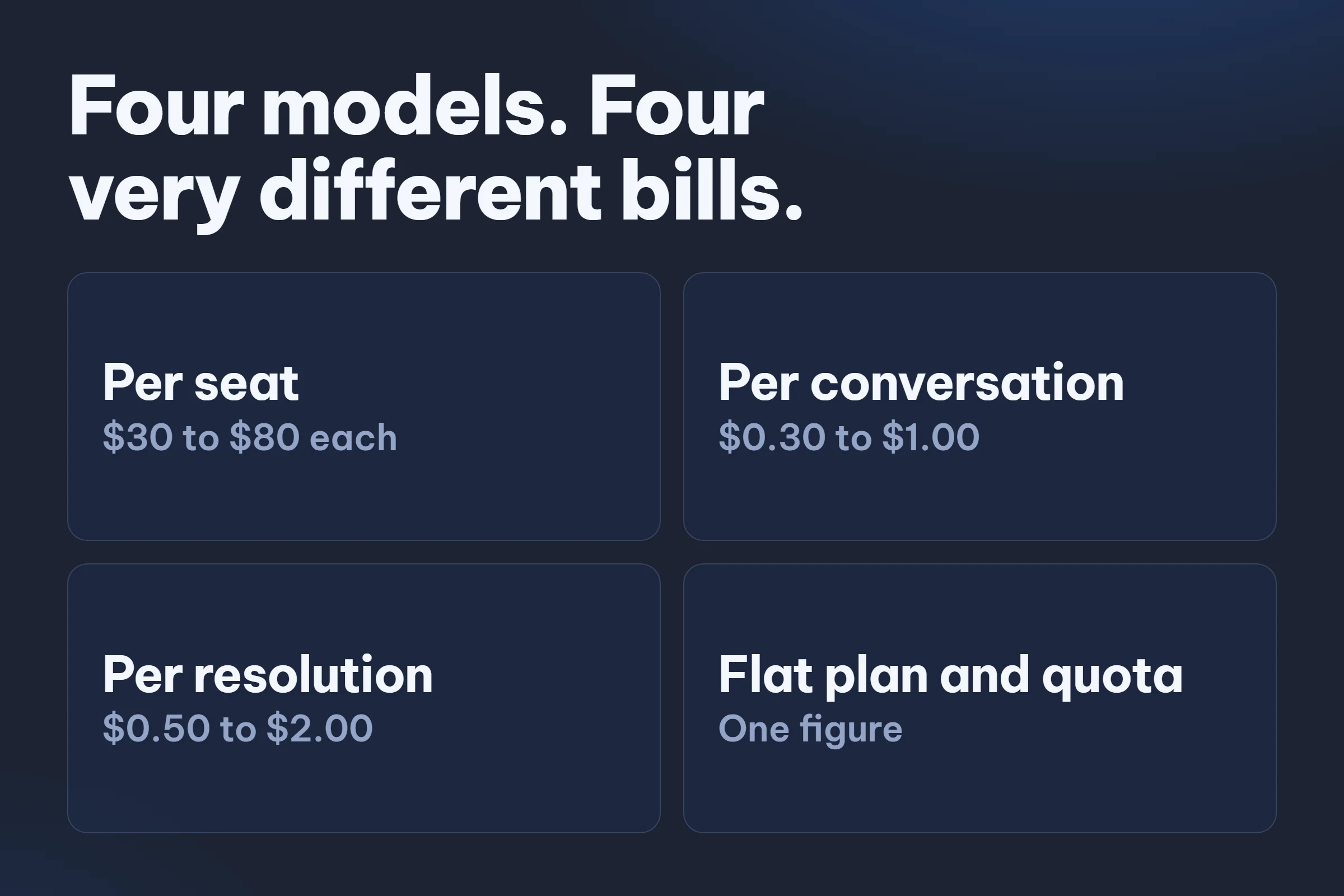
Per seat. You pay a monthly fee for each person on your team who can answer, typically between $30 and $80 each. This is the oldest model and it comes from live chat, where the cost of the service really was a function of how many humans were logged in. Intercom lists from $29 per seat per month on annual billing.
Per conversation. You pay for each conversation, whether or not the assistant was any use, typically $0.30 to $1.00 each, or bundled into a plan with a monthly allowance. Tidio counts billable conversations this way, with 100 included on its Starter plan at $29 a month.
Per resolution. You pay only when the AI settles a conversation without handing it to a person, typically $0.50 to $2.00 a time. Intercom charges $0.99 per resolution by its Fin agent, on every plan, on top of the seat.
A flat plan with a quota. You pay one monthly figure that includes a set number of conversations, and the AI is inside that figure rather than beside it. This is what Sublex Chat does: $29 a month, or $24 billed yearly, for 500 conversations.
All four are in wide use, and three of the four are metered. The difference between them is what triggers the meter, and that difference decides everything else.
The arithmetic nobody shows you
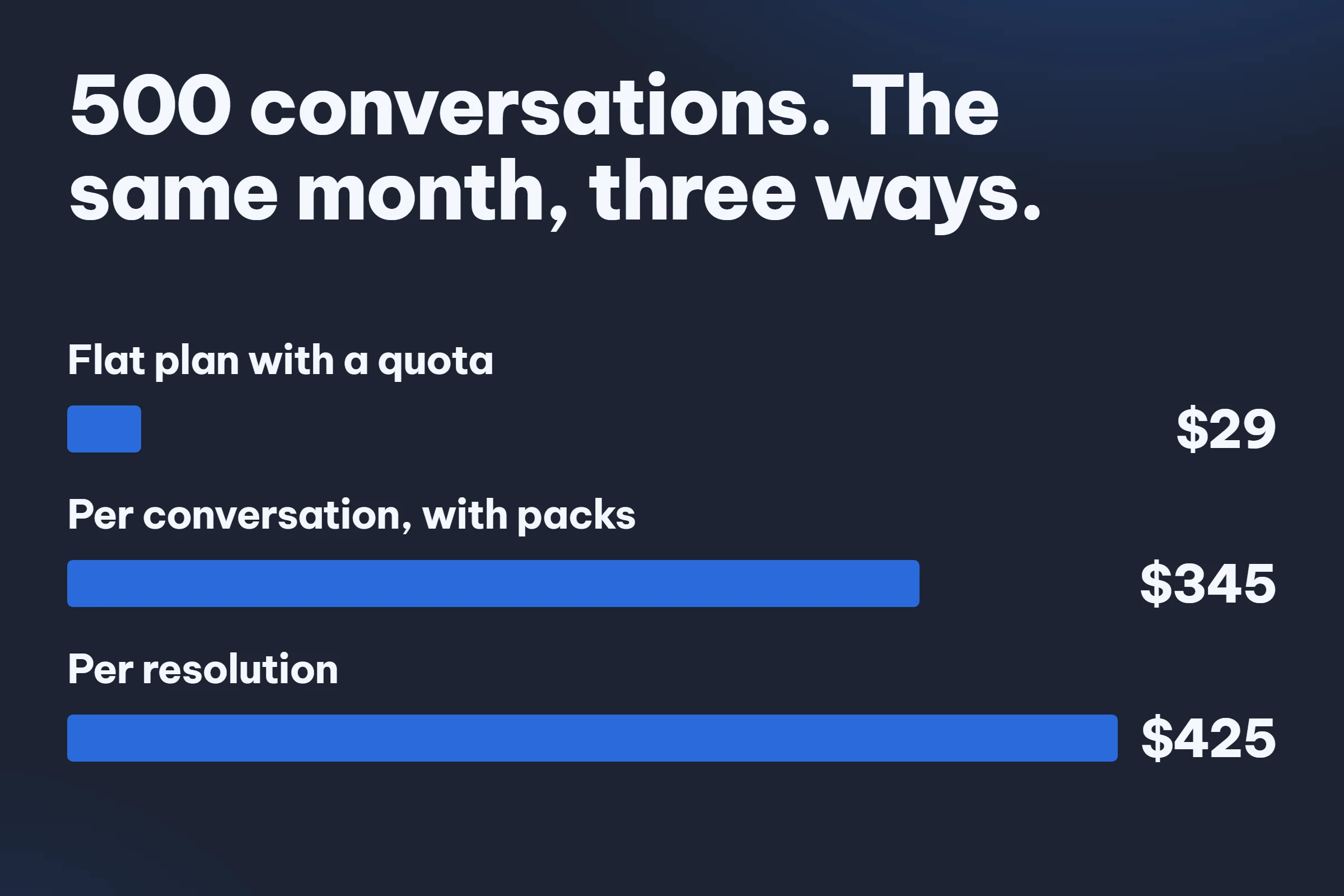
Take a small business with 500 customer conversations a month, one person answering, and an assistant that handles 80 per cent of them without help. That is 400 resolutions and 100 handovers, which is a realistic split and a generous one to the AI.
Here is what that same month costs under each model, using published prices.
| Model | The sum | Monthly |
|---|---|---|
| Flat plan with a quota | Sublex Chat Starter, 500 conversations included | $29, or $24 billed yearly |
| Per seat, AI sold separately | One seat at $29 on annual billing, and the AI agent priced on top | $29 plus the AI |
| Per conversation, packs | Botpress Plus at $150 annually covers 250, then 3 packs of 100 at $65 | $345, plus a separate AI usage meter |
| Per resolution | One Intercom seat at $29, plus 400 resolutions at $0.99 | $425 |
Those are not typos, and they are not a trick of picking the worst plan. They are the published rates applied to one ordinary month. The gap between the top row and the bottom two is not a discount. It is a different unit being counted.
The per resolution number is the one that surprises people, so it is worth stating the mechanism plainly. At $0.99 a resolution, an assistant that handles 400 conversations bills $396 before anybody has logged in. The same assistant handling 4,000 bills $3,960.
The growth trap
Read that last sentence again, because it contains the whole problem with per resolution AI chatbot pricing.
Under that model, your bill rises exactly in step with how well the product works. Improve your website so the assistant can answer more, and you pay more. Add the documents that let it handle the awkward questions, and you pay more. The better it gets at its job, the more it costs you, and the only way to reduce the bill is to make it worse.
Every other business expense you have works the other way around. A member of staff who gets faster does not invoice you more. Software that saves you an hour does not charge by the hour saved.
There is a fair defence of the model, and it should be said. Paying per resolution means paying only for work that actually got done, which is more honest than paying for conversations the assistant fluffed. At very low volume it is genuinely cheap. And the vendors charging it are usually selling a whole support desk rather than a chat widget, so the comparison is not like for like.
But the incentive it creates is real, and a small business should understand it before signing rather than after the third invoice.
The meters that are easy to miss
The advertised price is rarely the whole bill. Four things move it, and all four are common enough that any comparison of AI chatbot pricing that ignores them is wrong.
The AI is a second subscription. On Tidio, the Lyro AI agent is priced separately from the plan, from $32.50 a month on annual billing. The plan buys the live chat. Answering automatically is the other subscription. Read an entry price of $24.17 with that in mind and the real starting figure is nearer $57.
Your own branding costs extra. Chatbase prices removal of its badge at $99 a month on top of the plan. Tidio lists custom branding on its Plus tier, from $300 a month. That is a line item for not advertising somebody else on your own website.
AI usage is metered underneath the plan. Botpress runs a separate AI spend meter alongside the conversation quota, including $25 a month of usage on Plus and $150 on Team. Two meters, one product.
Overage buys itself. Botpress adds a pack of 100 conversations automatically at 95 per cent of quota, at $65 a pack on Plus. Their own FAQ answers the question "can I turn off auto recharge" with one word: no.
None of this is hidden. All of it is on the published pages. But it is spread across a pricing page, a comparison table and an FAQ, which is why so many people discover the real number on an invoice.
Where each model actually wins
No AI chatbot pricing model is a scam, and none of them is right for everybody. Here is the honest allocation.
Per seat wins when your volume is high and your team is small. If two people handle three thousand conversations a month, paying for two seats is far cheaper than paying for three thousand of anything. This is the model's original logic and it still holds.
Per resolution wins at genuinely low volume, and when you want the cost to disappear entirely in a quiet month. Fifty resolutions at $0.99 is fifty dollars, and nobody is going to argue with that.
Per conversation wins when your conversations are short and mostly successful, because you are paying roughly for what you got.
A flat plan with a quota wins when you want to know the number in advance. It is the model that makes the bill a fixed cost rather than a variable one, which matters more to a business with a marketing budget than to one with a support department.
And here is where a flat quota is the wrong answer, which is the part a pricing page rarely spells out. If you run more conversations than the largest plan includes, a quota becomes a ceiling. Sublex Chat's largest plan carries 2,000 conversations a month. Above that you are into either top-up packs or a different kind of product, and at several thousand conversations a month with a real support team, per seat billing will very likely cost you less. A business at that size should buy the support desk, not the widget.
Working out your own number
The example above is one business. Yours will differ, and the sum takes about five minutes on the back of an envelope.
Start with enquiries, not visitors. Count how many people actually contacted you last month, across every route: the contact form, the phone, WhatsApp, email, and anyone who walked in asking something they could have looked up. That total is closer to your future conversation volume than your website traffic is, because an assistant answers the people who would otherwise have asked.
Assume the assistant handles somewhere between half and four fifths. Below half suggests the material is thin. Above four fifths is possible on a good site with a decent knowledge base, and is not a figure to plan a budget around before you have seen it happen.
Then apply each model to those two numbers. Under a flat plan you pay the plan and the arithmetic ends. Under per resolution you multiply the handled share by the rate and add the seats. Under per conversation you multiply the whole volume, successes and failures alike, and add any packs. Under per seat you count the people who need a login and ignore volume entirely.
Do it again at three times the volume. This is the step that changes minds, and it is the one nobody does. AI chatbot pricing that looks identical at 100 conversations a month is rarely close at 300, and a business that expects to grow is buying the shape of the curve rather than today's figure.
Price is only half the decision. The other half is whether the answers can be trusted, which has five checks of its own and costs far more to get wrong.
If you are buying on behalf of clients rather than for yourself, the sum is a different one, and adding it to a website care plan is worked through separately.
The point of the exercise is not to find the cheapest product. It is to know which number on your invoice will move when your business does.
What to ask before you sign
Six questions, answerable from any pricing page in about ten minutes.
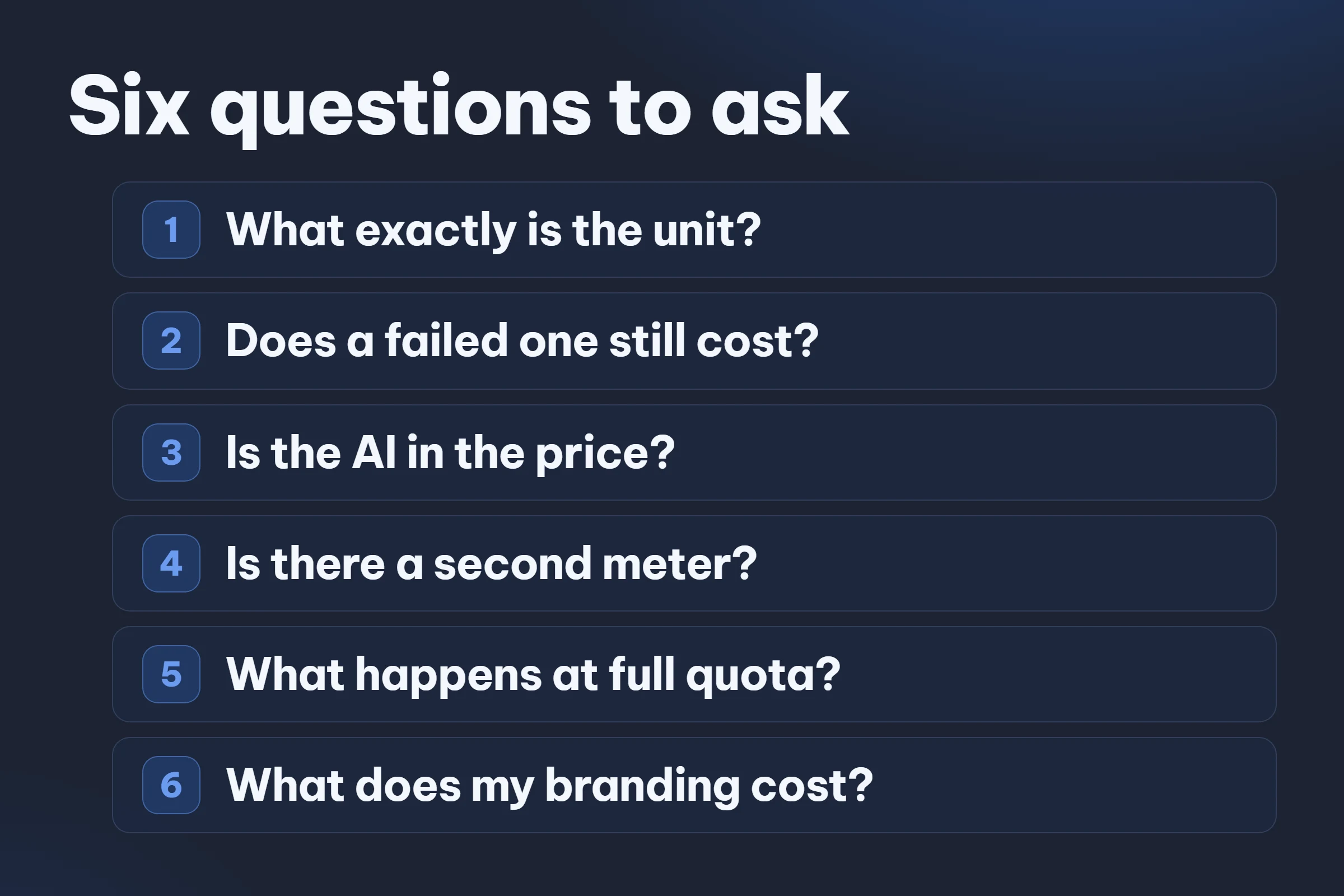
1. What exactly is the unit? A conversation, a message, a resolution, a seat, or a credit. Then ask what ends a conversation. Thirty minutes of quiet, fifteen messages and a new day are all in use, and they produce different counts from identical traffic.
2. Does a conversation the AI failed still cost me? Under per conversation billing it usually does. Under per resolution it usually does not. This single answer moves the bill more than the headline price.
3. Is the AI in this price, or beside it? If the pricing page has a separate line for the AI agent, add it before comparing anything.
4. Is there a second meter? AI usage, message credits, storage, and knowledge base size are all billed separately somewhere in this market.
5. What happens at 100 per cent of quota? Three answers are in circulation: the assistant stops and keeps taking enquiries, you are asked to buy more, or more is bought for you automatically. Find out which, and whether you can switch it off.
6. What does my own branding cost? Sometimes nothing, sometimes $99 a month, sometimes a tier that costs $300.
Where Sublex Chat sits
Sublex Chat takes the fourth approach to AI chatbot pricing: one number, one quota, one bill. Pricing is a free plan with 25 conversations a month that stays free, Starter at $29 a month or $24 billed yearly for 500, and Business at $79 a month or $66 billed yearly for 2,000. The AI is inside those figures. There is no separate AI subscription, no per resolution charge, no message credits and no second usage meter.
A conversation means one visitor's sitting, ending after thirty minutes of quiet or fifteen messages, and it counts only when the assistant actually answered something. A greeting somebody abandons is free. Anything your own team answers by hand is never metered, which matters because it means taking over a conversation does not cost you twice.
At 100 per cent of quota the assistant stops answering and keeps taking enquiries, so nothing is lost while you decide. Nothing is charged that you did not press a button to buy, and no plan upgrades itself.
If that is the shape you want, the comparison pages set it against the products most people look at first, each using their own published prices with the date they were checked. And before any of it, the assistant will read your website and answer questions about your business without an account, which is a better basis for a decision than a pricing table.
Frequently asked questions
How much does an AI chatbot cost for a small business? Between nothing and several hundred dollars a month for identical usage, depending entirely on the billing model. A flat plan with a conversation quota typically runs $25 to $80 a month at small business volumes. Per resolution billing at $0.99 a time reaches similar money at around 30 to 80 resolutions and keeps climbing from there. Per seat billing runs $30 to $80 for each person who answers.
What is the difference between per conversation and per resolution pricing? Per conversation bills you for the attempt. Per resolution bills you only when the AI settled the matter without a person. Per resolution is fairer on a bad answer and much more expensive on a good one, because the bill grows as the assistant improves.
Why is AI chatbot pricing so hard to compare? Because the unit differs between vendors, most pricing pages default to annual rates without saying so, and several products run more than one meter at once. Comparing headline prices across two vendors using different units tells you nothing.
Is a free AI chatbot plan enough for a small business? For testing, usually. For a live site, rarely, because free tiers tend to cap at a few dozen conversations a month and often carry the vendor's badge. They are a reasonable way to find out whether customers use the thing at all before paying for it.
What should I budget for the first year? Take your real enquiry volume, decide which model you are buying, and add every separate meter on the page before comparing. For most small businesses on a flat plan the answer lands between $290 and $950 a year. Under per resolution billing at a few hundred resolutions a month it is several thousand.
Do these prices change? Frequently. Every price quoted here was read from that product's own published pricing page on 1 September 2026, with the billing toggle checked in both states. Check the source before relying on any of it, including this page.
See Sublex Chat answer from your own website
Give your web address and watch it read your pages, then answer questions about your business. No account needed.