Website Care Plan: Add One Line Clients Can See
Sublex Digital · 3 September 2026 · 12 min read

A website care plan is the best thing a web design studio can sell. It turns a business that starts from zero every January into one with money arriving whether or not anybody signed a proposal that month, and it is the single change that most raises what an agency is worth if it is ever sold.
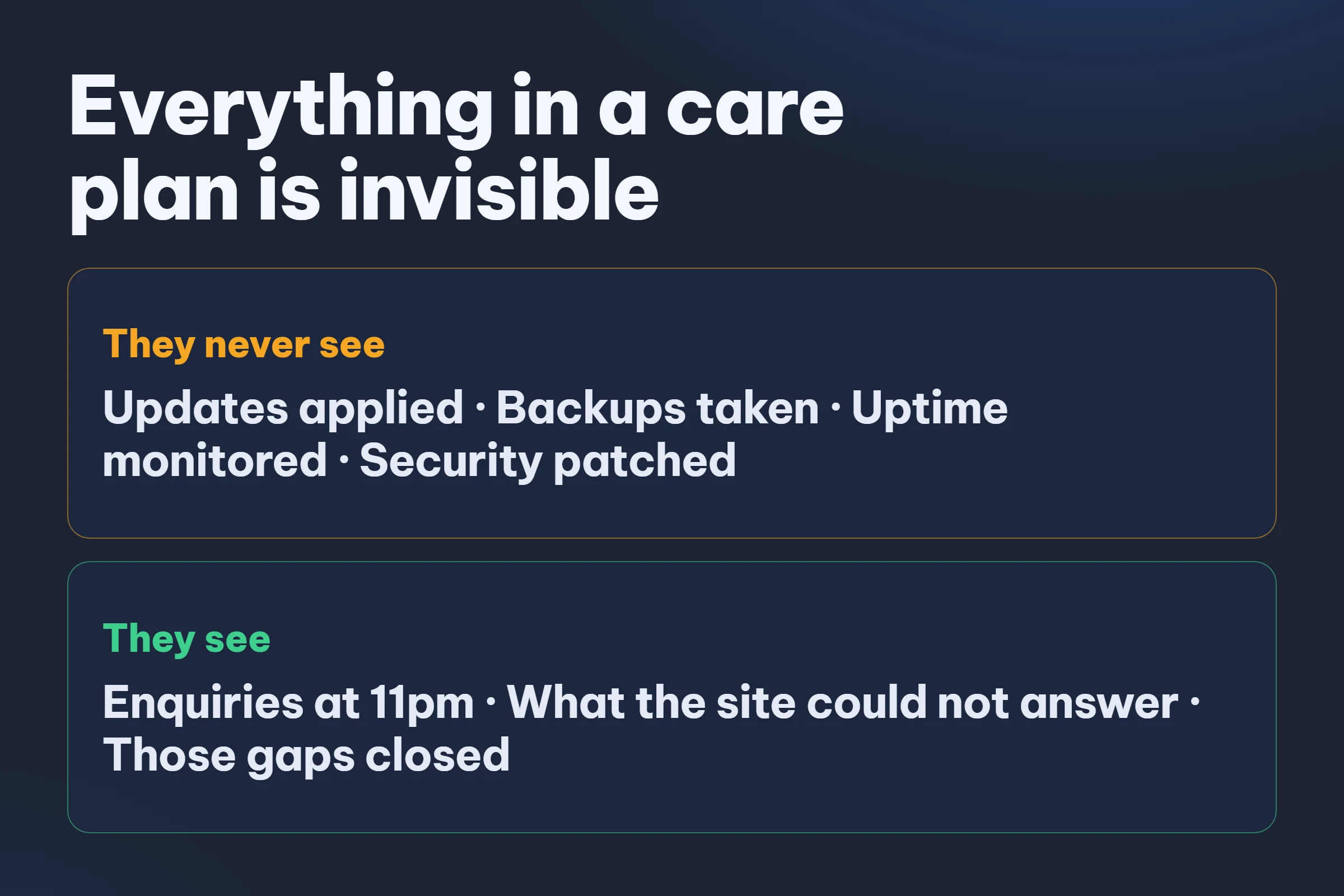
It is also the easiest line on a client's bill to cancel, and the reason is not the price. It is that almost everything in a standard care plan is invisible. Updates applied, backups taken, uptime monitored, security patched, a plugin bumped from 4.1 to 4.2. All necessary. None of it visible to the person paying, who experiences a good month and a bad month as exactly the same: a website that sat there.
When the client's own revenue dips and they go through the direct debits looking for something to cut, the line they cannot picture is the line that goes.
Why a website care plan gets cancelled
Ask an agency why a website care plan lapsed and the answer is usually "they said they could not justify it". That phrasing is worth taking literally. The client could not justify it, to themselves or to a partner, because they had nothing to point at.
A care plan is insurance sold as a subscription. Insurance is a hard sell in a quiet year, and every year the site does not break is a quiet year. The better the maintenance, the less evidence there is that it is working. That is a genuinely difficult position to sell from, and no amount of nicer reporting fixes it, because a report saying "17 updates applied, no incidents" is still a report about nothing happening.
The way out is not to explain the invisible work better. It is to put one item in the plan that produces something the client can see every month without being told to look.
What clients actually notice
There are only three things a small business owner reliably notices about their website: money coming in, their phone ringing, and somebody complaining. A care plan item that touches any of those defends itself.
An assistant answering questions on the site touches all three. Enquiries arrive that would otherwise have bounced at eleven at night. Contact details get captured from people who were not going to fill in a form. And every question the site could not answer is written down, which turns into a short list of things to fix that the client can see being fixed.
That last one is the part agencies underrate. A monthly note that says "your website could not answer these four questions, and I have added the answers" is a report about work done, in the client's own vocabulary, generated by the thing rather than written by you. It reads as attentiveness rather than as maintenance.
The economics, honestly
Here is the part that decides whether this is worth your time, so it should be stated without decoration.
Typical care plans run from about $49 to $150 a month, and a widely used rule of thumb sets them at 10 to 20 per cent of the original build cost per year. Retention, once a plan is running, is generally quoted above 80 per cent.
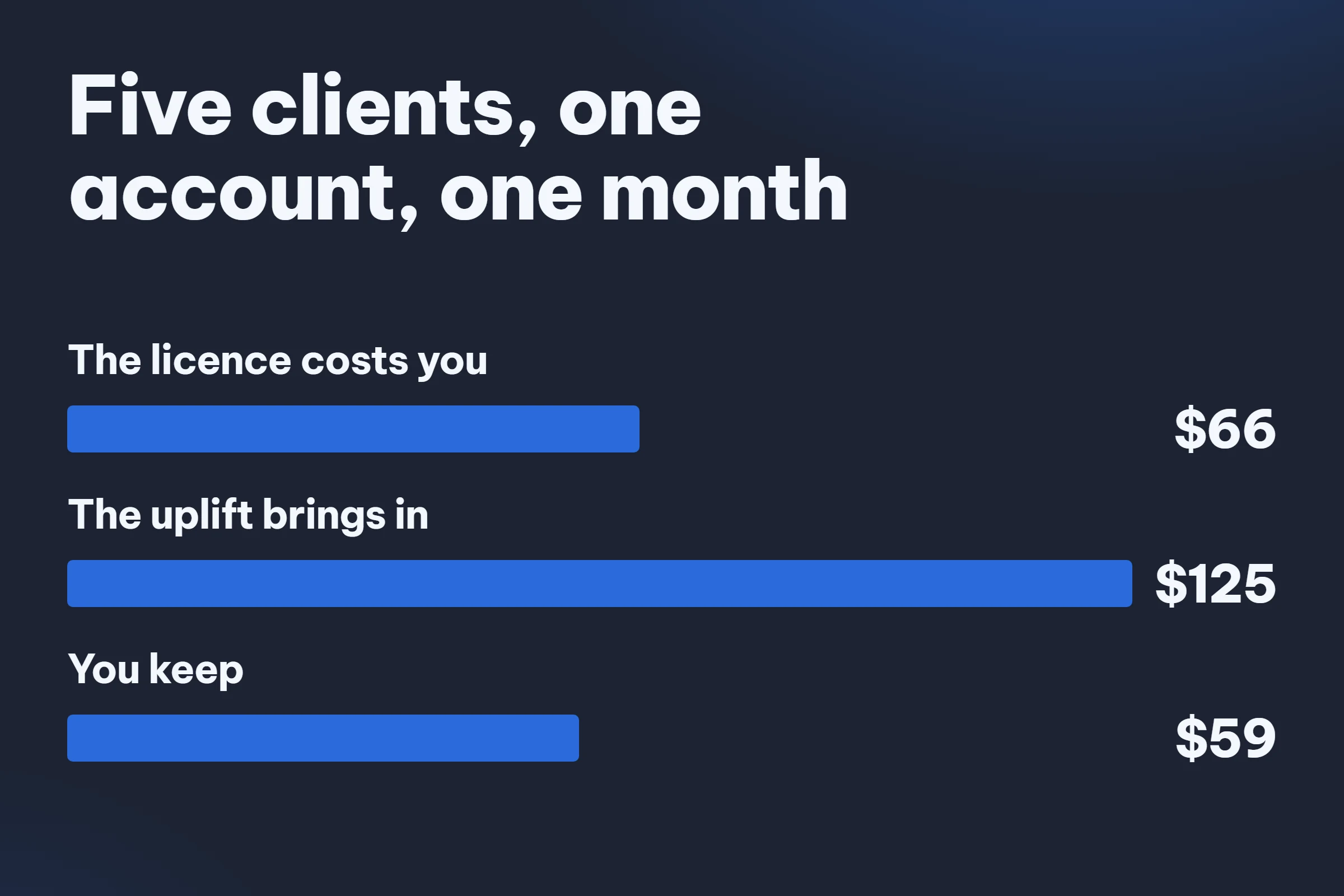
The licence cost of adding an assistant across a handful of clients is small, and so is the margin on it. On Sublex Chat the Business plan is $79 a month, or $66 billed yearly, and carries five assistants, so five clients can each have their own assistant under one account, with the "Powered by" badge removed and the launcher wearing the client's own icon and colour.
Five clients, an uplift of $25 a month each, is $125 in and $66 out. About $59 a month of margin, or a little over $700 a year.
That is not the reason to do it. Nobody is retiring on $700. The reason to do it is that five care plans which were cancellable are now harder to cancel, and a care plan at $100 a month held for an extra two years is worth $2,400 per client. The licence margin is a rounding error next to the retention it buys.
One caveat, stated plainly because it is the sort of thing that ruins a month if it arrives as a surprise: the conversation quota is shared across the account, not allocated per client. The Business plan carries 2,000 conversations a month between the five assistants. For five small local businesses that is comfortable. For one busy client and four quiet ones it still works, because the quiet ones use almost nothing. For five high-traffic sites it does not, and that is a conversation about terms for resellers and managed clients rather than a plan you buy off the page.
The work it actually adds
The reason most website care plan upsells never get sold is that they add work the agency has to do every month. This one is close to zero, and it is worth being specific about where the hours go.
Setup, about fifteen minutes a client. You give the assistant the client's web address and it reads the site itself. There is no flowchart to draw, no intents to define and no training data to prepare. Add the client's price list or PDFs if they have any. Paste one line into the site, which on WordPress is the same place you already put analytics.
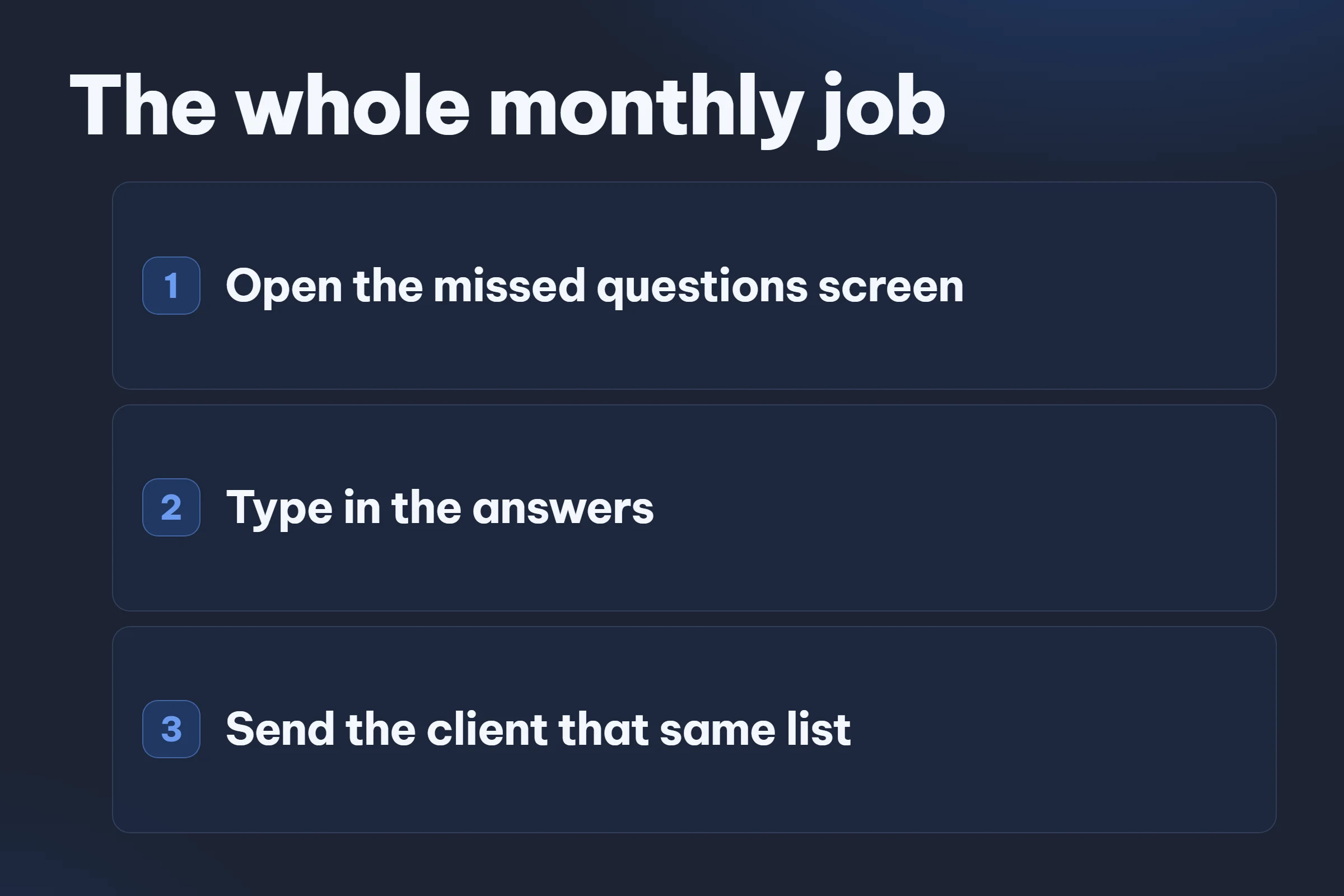
The monthly job, about ten minutes. Open the missed questions screen, read the handful of things the assistant could not answer, and type the answers in. That is the entire recurring workload, and it is also the thing you send the client as evidence, so it is not overhead at all. It is the report.
What you do not take on. You are not on the hook for answering customers. The assistant answers from the client's own material or says it does not know and takes a phone number. If a client wants a human to reply in the chat, that is their staff on their side, not yours.
Where this is the wrong idea
Three cases where this does not belong in a website care plan, and it is worth knowing them before you sell it rather than after.
Clients with no written material. The assistant answers from what the business has published. A four-page brochure site with no prices, no policies and no detail gives it almost nothing to work with. The honest sequence there is a content project first, and the assistant afterwards, which is a better sale anyway.
Clients who want a scripted flow. If what the client actually wants is a branching questionnaire that qualifies leads down a decision tree, that is a different category of product and there are good ones. This answers questions from material. It does not run a script.
More than five clients. Five assistants is the ceiling on the largest published plan. Beyond that the answer is reseller terms rather than stacking accounts, and stacking accounts is a bad idea anyway because you lose the one dashboard.
How to add it to a plan that already exists
You do not need a new proposal, and you should not rewrite the website care plan to add it. The move that works is to install it on one client's site, run it for a month, and then show them what it caught.
Pick your most talkative client. The one whose customers ring with the same three questions. Their site produces evidence fastest.
Do not tell them in advance. Install it, leave it a month, then send the missed questions list and the enquiries it captured. A conversation that starts with "here is what your website could not answer last month" is a different conversation from one that starts with "I would like to add $25 to your bill".
Then price it into the renewal, not as an addition. A care plan going from $95 to $120 at renewal, with a new visible item in it, is a far easier sentence than an extra line item appearing on an existing bill.
Roll it out to the rest as their renewals come round. Five clients is one plan. There is no rush to fill it on day one.
The monthly email, which is the whole report
The reason this survives contact with a busy month is that the report writes itself. Here is the shape that works, and it takes about two minutes once the missed questions screen is open in front of you.
Subject: Your website, August Four things your customers asked last month that the site could not answer: whether you deliver to Brikama, whether the deposit is refundable, what time you close on Saturdays, and whether you take instalments. I have added answers to the first three, so it will handle them from now on. The fourth is a business question rather than a website one, so tell me what you want it to say. It also captured eleven enquiries, six of them after six in the evening. They are attached.
That is the entire deliverable, and notice what it is not. It is not a list of plugin versions. It contains no jargon, nothing the client has to decode, and no request for them to do anything except answer one business question. It reads as somebody paying attention to their business, which is what a website care plan is supposed to feel like and almost never does.
Send that eleven times and the twelfth month's renewal is not a conversation.
Pricing it into the plan
Three tiers cover most studios, and the numbers below are a starting point rather than a rule, because what you can charge depends on your market.
| Tier | What the client gets | Typical uplift |
|---|---|---|
| Included | The assistant runs, the monthly email arrives | $15 to $25 a month |
| Managed | The above, plus you write the answers to the missed questions | $35 to $60 a month |
| Content | The above, plus you write the missing pages the questions reveal | Quoted per job |
The third tier is the interesting one, and it is the reason to read the missed questions list yourself rather than forwarding it. A month of questions the website could not answer is a specification for the pages it is missing, written by the client's own customers. That is the easiest content project anybody ever sold, because the brief arrived unprompted and the client already believes it.
A website care plan built this way stops being a cost the client tolerates and starts being the thing that tells them what to fix next.
What to tell the client it is
Avoid the word chatbot if you can. It carries fifteen years of baggage about menus of buttons that never contained the option anyone wanted.
The description that lands is closer to this: it reads your website and answers your customers from what is on it, at any hour, in whatever language they write in. When it does not know, it says so and takes their number rather than guessing. And every question it could not answer comes to me, so your site gets better every month.
That last clause is the one that sells the care plan, because it describes your work.
Frequently asked questions
What should a website care plan include? The invisible essentials are updates, backups, uptime monitoring, security checks and a monthly report. The part most plans lack is anything the client can see working. One visible item, producing evidence each month, is what makes the rest of the plan defensible when they are looking for something to cut.
How much should I charge for a website care plan? Common ranges run from about $49 to $150 a month, and a frequently used floor is 10 to 20 per cent of the build cost per year. What you can charge depends less on the hours than on whether the client can describe what they get for it.
Can I put an AI assistant on client sites under one account? On Sublex Chat's Business plan, five assistants sit under one account, each reading its own client's website, with the badge removed and the launcher in the client's own colour. The conversation quota is shared across the account rather than split per client. Above five clients, ask about reseller terms.
Does the client see it is not my own product? The badge is removed on the Business plan, and the chat window carries the client's colour, launcher icon and wording. The dashboard is not rebranded, so anyone you give a login to sees the product's name. Most agencies keep the dashboard to themselves and send the client the monthly summary instead.
How long does it take to set up per client? About fifteen minutes. You give it the web address, it reads the site, you add any documents, and you paste one line into the site. There is nothing to train and no flow to build.
What happens if it gives a client's customer a wrong answer? It answers only from the material the client gave it, and says so plainly when the answer is not there rather than inventing one. That distinction is worth understanding properly before you put anything on a client's site, and it has five checks of its own.
See Sublex Chat answer from your own website
Give your web address and watch it read your pages, then answer questions about your business. No account needed.