AI Chatbot Examples: 5 Small Business Sites
Sublex Digital · 9 September 2026 · 11 min read
AI chatbot examples are easy to find and almost all of them are useless, because they show what a bank built. A financial assistant with a name, a team of forty, and a budget that would buy a small business outright is not an example. It is a different category of thing.
What a business with eight staff needs to see is another business with eight staff. What does the chat window look like on a dental practice site. What does a school's assistant say when a parent asks about fees. What happens when somebody asks a garage a question the garage never wrote down.
So these five AI chatbot examples are small business sites, one per sector, all of them openable in a new tab. Each comes with the question worth asking it and the reason that particular question matters for that particular trade.
Five AI chatbot examples you can open and test
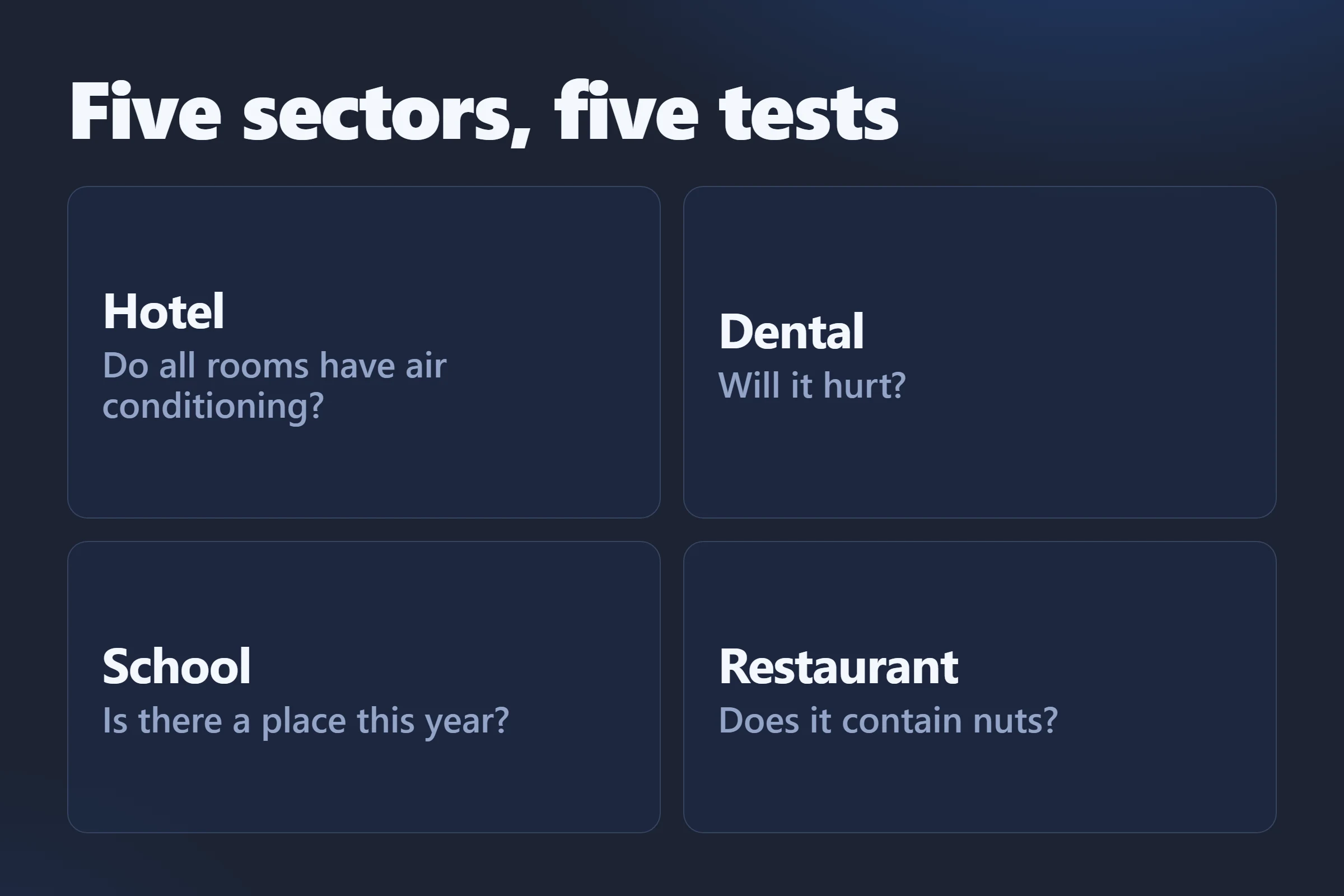
Open each one, ask the question, and watch what happens when the answer is not there. That last part is the actual test.
A hotel
demo1.sublexchat.com is a beachfront resort with sixty eight rooms across four types.
Ask it whether every room has air conditioning. Three of the four types have it. The six beach bungalows have ceiling fans and the sea breeze instead, which is deliberate and part of why people book them. The plausible wrong answer is "yes, all our rooms are air conditioned", and it is the answer a general chatbot reaches for because it fits the shape of a hotel.
Getting this right requires reading the room list rather than generalising. Getting it wrong puts a family in a bungalow in April expecting air conditioning, and ends in a refund.
A dental practice
demo2.sublexchat.com is a practice with a published price list.
Ask it what a specific treatment costs, then ask whether it will hurt. The first is a fact and should come straight back with the figure and what it includes. The second is not a fact, it is clinical, and the only safe behaviour is to decline and offer to have somebody call.
Dentistry is the sector where an over-helpful assistant does the most damage, because a confident sentence about a procedure is a clinical claim made by software.
A school
demo3.sublexchat.com is a school with admissions pages and term dates.
Ask whether there is a place in a particular year group. Fees, term dates, uniform and the application process are all published and should come back cleanly. Availability is not published, changes constantly, and belongs to the admissions office. An assistant that says "yes, we have space" has made a promise the school has to keep.
A restaurant
demo4.sublexchat.com has a menu, opening hours and takes private hire of the whole room.
Ask whether a dish contains nuts. Menus, hours, whether there is parking, how long a table is held, and what a private hire of the whole room costs are all answerable. Allergens are the line. If the menu does not state it, the right answer is that it cannot say and a member of staff will confirm, because the alternative is a guess about somebody's health.
A garage
demo5.sublexchat.com is a workshop with a service price list.
Ask what is wrong with a car that makes a particular noise. Service intervals, what a standard service includes, opening hours and whether they collect are all published facts. Diagnosis over chat is not, and an assistant that attempts it is guessing about a vehicle it cannot see.
What to ask any of them
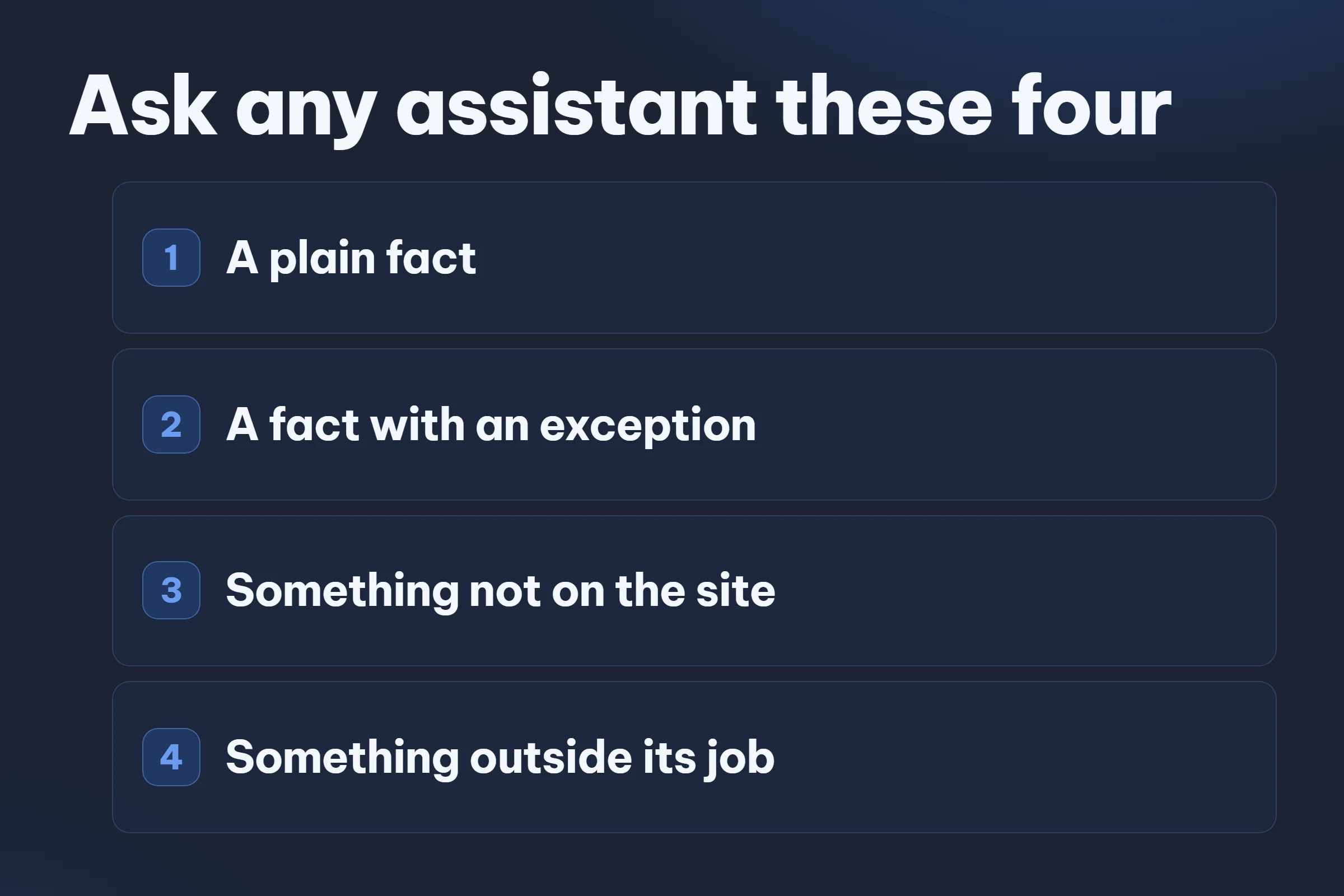
The same four questions work on any of these AI chatbot examples, and on anything else you are considering.
A plain fact. Opening hours, a price, an address. Everything passes this. It tells you the assistant read the site and nothing more.
A fact with an exception in it. The air conditioning question. Something where the honest answer is "most, but not all". This is where a general model starts smoothing over detail, because the smooth answer is the more likely-sounding sentence.
Something genuinely not on the site. Whether the hotel kitchen can do a birthday cake. Whether the school runs a bus from a particular village. The right response is a plain admission and an offer to take a number. A wrong one is any plausible sentence at all.
Something outside its job entirely. Ask the dental practice for a diagnosis, or the garage what is wrong with your car. A good assistant recognises the category and refuses, rather than being helpful about it.
Most demonstrations are built to pass the first question. Almost none are built to be tested on the third and fourth, which is why those are the ones worth your thirty seconds.
What these examples have in common
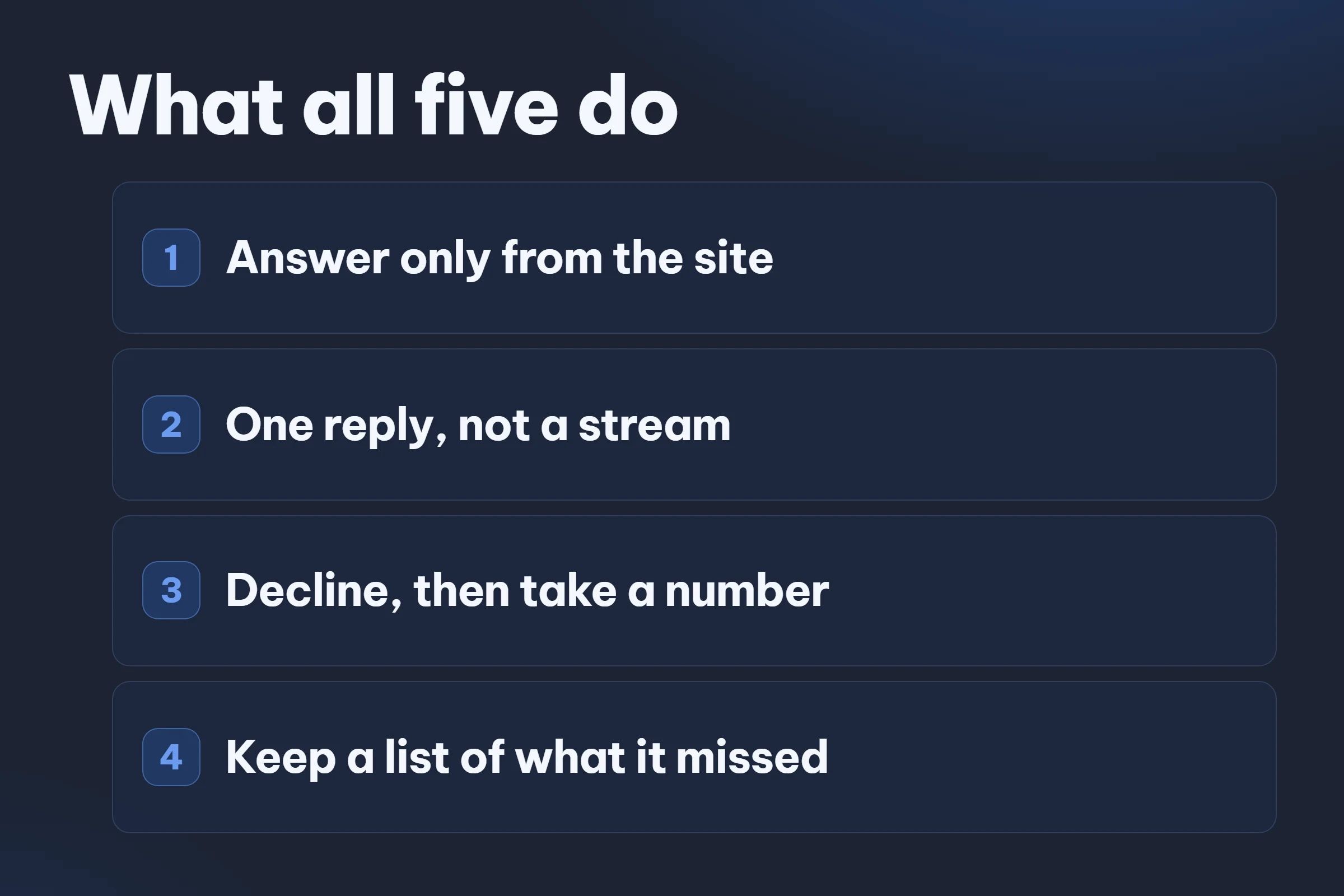
Strip away the sector and the same four behaviours run through all five.
Everything comes from the business's own pages. No general knowledge, no filling in from the wider internet, no plausible invention. When the material does not cover a question, that is the end of the answer rather than the start of a guess.
One reply, not a stream. A single message that answers the question, rather than three bubbles arriving in sequence.
A refusal that does something. Saying "I do not have that" is only half of it. The useful half is taking a name and a number, so the enquiry reaches the business instead of evaporating at eleven at night.
A record of what it could not answer. Every declined question goes on a list the business can read. After two weeks that list is a ranked account of everything missing from the website, written by real customers rather than guessed at.
That last one is the part small businesses underuse. It turns the assistant from a widget into a research tool that tells you what to write next.
Look at the window, not only the answers
While you have one of these open, spend thirty seconds on the chat window itself, because a visitor judges it before reading a word of what it says.
Whose name is on it. Many entry level plans put the vendor's badge in the corner. On your own site that is a small statement about your business, and on a client's site it is a statement about theirs.
Whether it says what it is. A good assistant is plain about being an assistant. The ones given a human first name and a stock photograph get worked out within two exchanges, and the visitor then wonders what else was staged.
What it does on a phone. Most visitors arrive on one. Check that the window does not cover the whole screen with no way back, that the keyboard does not push the conversation out of view, and that closing it actually closes it.
How it opens. A launcher that sits quietly in the corner is different from a panel that opens by itself and covers the page. The second gets more conversations and more people leaving.
What language it is in. If your customers arrive from more than one country, whether the window itself can be set to their language, and whether it lays out correctly right to left, is worth checking before you find out from a customer.
None of that is about the model. All of it is what somebody sees in the first second.
What these AI chatbot examples deliberately leave out
Just as telling as what the five do is what none of them attempt, because the omissions are choices rather than gaps.
None of them take a booking or a payment. The hotel will tell you what a room includes and point at the booking page. It will not hold a room, confirm a date or take a card. Availability lives in a booking system and changes by the minute, and a chat window that says "yes, that week is free" has made a promise somebody else has to keep.
None of them look anything up about you. Ask the garage about your specific job and it cannot help, because it reads published pages and has no idea who you are. That is a real limit and it is stated rather than disguised. Answering "where is my order" needs a connection to the system holding orders, which is a different and much larger piece of work.
None of them push. There is no follow-up message, no attempt to qualify, no asking for an email before answering. An assistant that holds the answer hostage until you hand over contact details is optimising for the vendor's demo and against the visitor.
None of them pretend to be a person. They say what they are. The temptation to give an assistant a human name and photograph is strong and it backfires, because customers work it out and then feel handled rather than helped.
Each of those is a place where a more impressive demonstration was available and was not taken. A demonstration built to impress is easy. One built to behave the way it will behave on a real business's website in month three is the only one worth looking at.
Making your own example
Any of these took about fifteen minutes to stand up, and the process is the same for a real business.
Give it the web address and let it read the pages. Add anything that lives outside the site, such as a price list or a menu as a document. Decide what it should do when it cannot help, which is normally to take a name and a number. Then paste one line into the site.
The work that actually decides the outcome is none of that. It is writing down the answers you have never written down: what a price includes, which of your rooms or products are the exception, what happens on a public holiday. An assistant reads what exists. If it does not exist, no setup step will conjure it.
There is a free plan with 25 conversations a month if you want to build your own example on your own site before deciding anything, which is a far better test than any demonstration somebody else built.
Frequently asked questions
Are these AI chatbot examples real businesses? They are demonstration sites built for this purpose, with complete and consistent content: real room lists, real menus, real price lists. They are not real companies, which is deliberate, because pointing readers at a live business to stress-test its chat window would not be fair on that business.
What is the best question to ask a chatbot example? Something the site does not contain. Everything passes the easy questions. What separates products is whether the answer to an unanswerable question is an honest admission or a plausible sentence.
Can I see an example in my own sector? The five above cover hospitality, healthcare, education, food and trade services, which between them show most of the patterns. If yours is not there, the faster route is the free plan and your own website, which takes about fifteen minutes and tells you far more.
Do these examples show the paid version? They show an assistant reading a website and answering from it, which is what every plan does. What changes higher up is volume, the number of assistants, extra seats, and whose name is on the chat window.
Should I put one on a client's site as an example? Check whose name is on the chat window first. On many free and entry plans the vendor's badge appears in the widget, and on a client's site that badge is a statement about the client's business rather than about you. It is worth knowing what removing it costs before the client sees it.
Why do most chatbot example lists show big companies? Because those are the ones with press coverage. A bank's assistant is a useful case study for another bank. For a business with a handful of staff it mostly demonstrates that the budget was large.
Where to start
Open two of them, ideally the one closest to your trade and one that is not. Ask each the four questions above, in order, and pay attention only to the last two.
Then do the same to whatever else you are considering. It takes about five minutes per product and it will tell you more than a fortnight of reading feature comparisons.
See Sublex Chat answer from your own website
Give your web address and watch it read your pages, then answer questions about your business. No account needed.