AI Chatbot for Customer Service: What It Can Do
Sublex Digital · 8 September 2026 · 11 min read
An AI chatbot for customer service is sold on a percentage. Seventy per cent of enquiries handled, or eighty, or ninety. The number is always somebody else's, measured on somebody else's questions, and it tells you nothing about what would happen on your site.
The number that matters is yours, and you can work it out in an hour with last month's messages. It depends on one thing: how many of the questions you receive can be answered from something you have already written down. That share is your ceiling, and no model, however good, moves it.
This is a guide to finding that number, and to the four things that make an AI chatbot for customer service fail even when the share is high.
The three tiers of customer service question
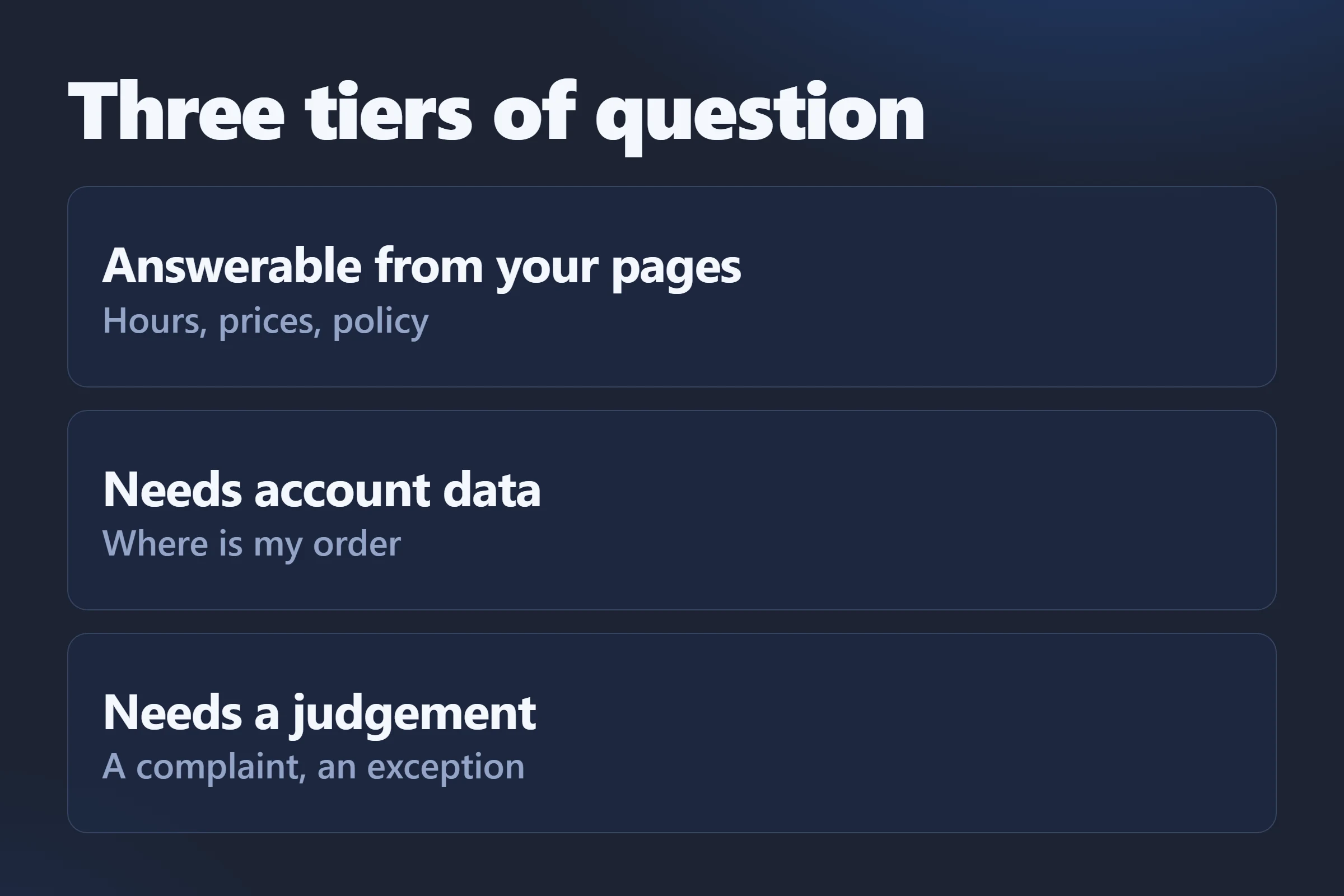
Every enquiry a business receives falls into one of three tiers, and the difference decides everything.
Tier one is answerable from what you published. Opening hours. Whether you deliver to a particular area. What is included in a price. Whether a room has a bath. What documents an application needs. Whether you are open on a public holiday. What your returns window is. These are questions of fact, the facts already exist somewhere on your site or in a document, and the customer simply could not find them.
Tier two needs account data. Where is my order. Has my payment gone through. When is my appointment. Can you change the date on my booking. These are answerable, but only by a system that knows who is asking and can look them up, which means a connection to your order system or your booking system rather than to your website.
Tier three is judgement. A complaint. A request for an exception. A refund that is outside policy. Anything where the right answer depends on who the customer is, how much they have spent, and what you are willing to do. There is no correct answer sitting in a document, because the answer has not been decided yet.
An assistant that reads your website serves tier one. That is the whole scope, and being clear about it is what separates a product that works from a disappointment.
What a resolution rate actually measures
When a vendor says an AI chatbot for customer service resolves seventy per cent of enquiries, what that usually means is that seventy per cent of the enquiries in their sample were tier one.
That is not dishonest, but it is not transferable. A software company with a large documentation site has a very high tier-one share, because almost everything a customer asks is written down somewhere. A repair business has a low one, because most questions are about a specific job on a specific vehicle. Same product, same model, wildly different result.
There is a second thing hidden in that number. Some vendors count a resolution as any conversation where the customer did not go on to open a ticket. A customer who gave up counts as resolved. Ask how it is measured before you believe it, and treat any figure quoted without a definition as marketing.
How to work out your own number in an hour
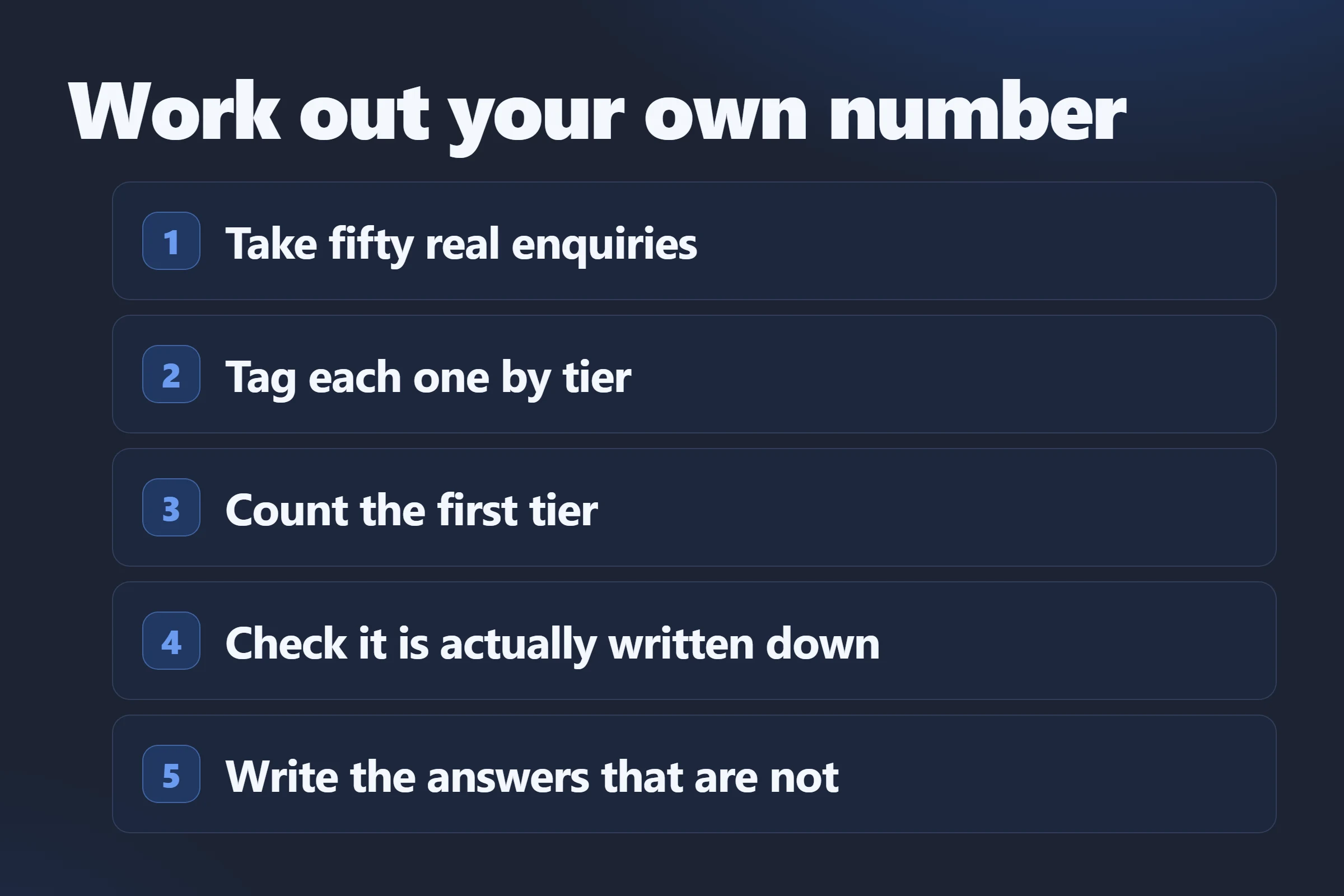
This is worth doing before you spend anything, and it works whichever product you end up choosing.
Take the last fifty enquiries you actually received, from every channel: email, messaging, the contact form, and notes from phone calls if you keep them. Fifty is enough. A hundred is better and takes twice as long.
Tag each one with a tier. One if the answer is a fact. Two if it needs to look something up about that person. Three if somebody has to decide.
Count the ones. That percentage is your realistic ceiling.
Now check the ones honestly. For each tier-one question, find where the answer lives on your website. A surprising share will turn out not to be there at all: you know the answer, you have said it a hundred times, and you have never written it down. Those are not tier one yet. They are tier one once you write them.
Write the missing answers. This is the actual work of setting up an AI chatbot for customer service, and it is the part no product does for you. It is also worth doing on its own merits, because those answers on your website will deflect enquiries before anybody opens a chat window at all.
For most small businesses the exercise lands somewhere between forty and seventy per cent tier one, with a meaningful chunk of it not yet written down. That is a much more useful thing to know than any published benchmark.
Four ways an AI chatbot for customer service still fails
A high tier-one share does not guarantee a good outcome. Four things break an otherwise sound setup, and all four are checkable before you commit.
It answers when it should decline. The single most expensive failure. A customer asks something outside the material, and instead of saying so the assistant produces a confident, plausible sentence. Now you have a wrong answer with your name on it, published to a customer, at an hour when nobody is watching. This is worth testing for deliberately rather than hoping, and there are five checks that take about ten minutes.
It splits one answer across several messages. Irritating on a website. On a messaging channel it is also a direct cost, because most channels bill per message sent. One answer should be one message.
There is no handover, or the handover is a dead end. An assistant that cannot pass a conversation to a person is a wall, not a service. Worse is the one that says it will pass you to somebody and then does nothing, which customers experience as being lied to.
The knowledge goes stale. You change your prices in March and the assistant is still quoting February in June. Ask how often it re-reads your site, and whether that is automatic or something you have to remember to do.
What it changes for the people already answering
The part that gets least attention in a decision like this is what happens to the person who currently answers everything, and it decides whether the thing survives past month two.
The fear is reasonable and usually unspoken: that this is the first step towards not needing them. It is worth addressing directly, because the reality is close to the opposite. What an assistant removes is the fortieth repetition of the opening hours, which is the part of the job nobody defends. What it leaves is the enquiries that need a person, arriving with the routine ones already filtered out.
There is a second, more practical change. When every question arrives on one phone, there is no record of what customers keep asking, so nothing improves. When they arrive through an assistant, there is a list, and the list is ordered by frequency. A member of staff who spends twenty minutes a month reading it and writing three answers is doing the highest-value work available in a small business, and it compounds: every answer written is a question that never arrives again.
The failure mode to watch for is the opposite of the fear. It is the assistant that nobody owns, whose list nobody reads, quietly answering from a price page that changed in March. That is not a technology problem and no product prevents it. Give it to a named person with an hour a month, and say out loud that the hour is part of their job rather than something they fit in.
One more thing worth saying to a team before it goes live: the assistant is allowed to say it does not know. That sounds obvious, but staff who have been trained never to leave a customer without an answer often read a decline as a failure. It is the opposite. A decline that captures a phone number is a better outcome than a guess, and the people answering should know that is the standard it is being held to.
Handover is the feature, not the fallback
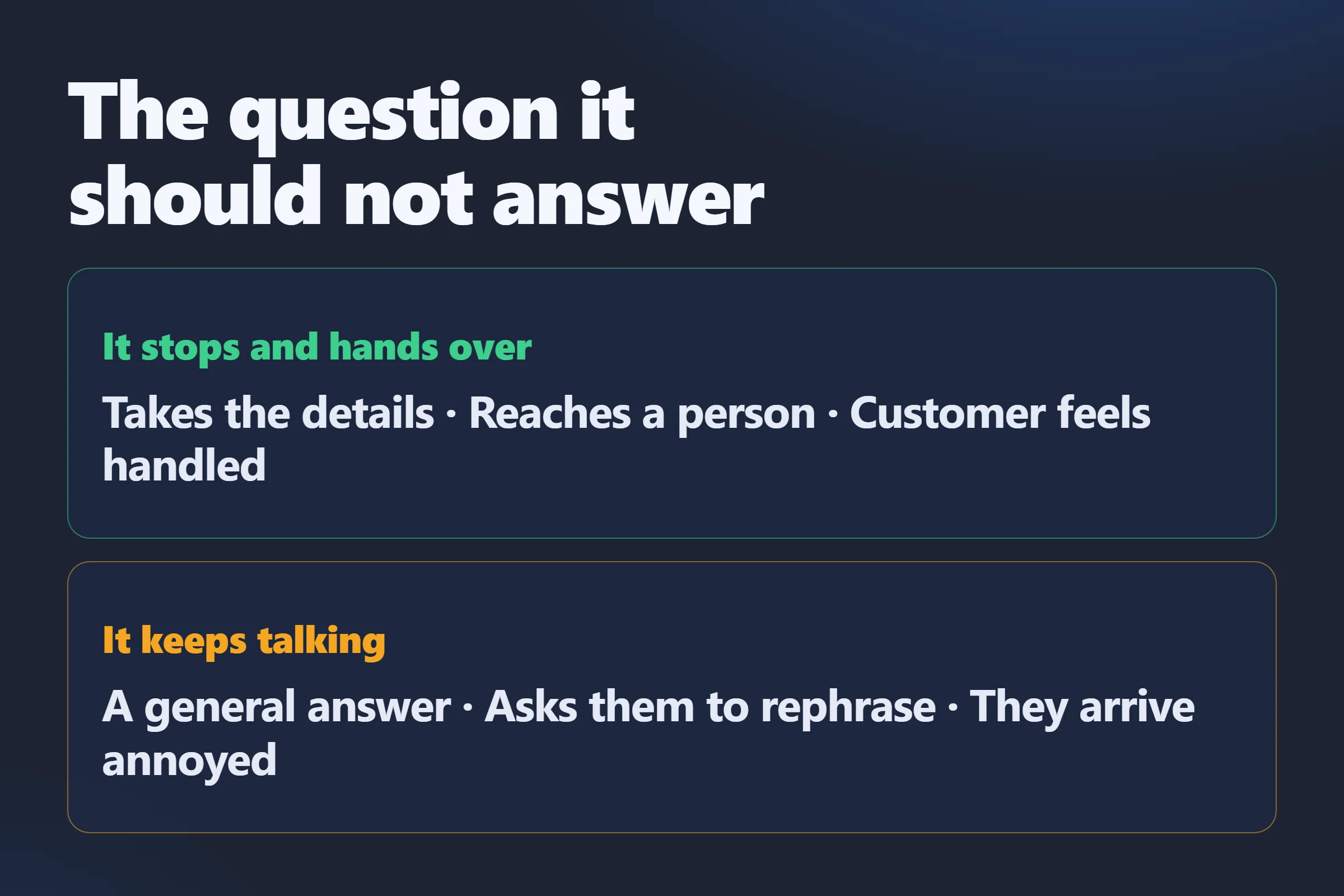
Most buyers evaluate an AI chatbot for customer service on how much it answers. The better evaluation is what it does with the questions it should not answer.
A good one recognises the boundary and stops. It says plainly that it does not have that information or that a person needs to deal with it, takes a name and a way to reach them, and puts the conversation somewhere a human will see it. The customer feels handled rather than blocked.
A bad one keeps talking. It offers a general answer to a specific question, or asks the customer to rephrase, or loops. Every extra exchange in that state makes the eventual human conversation worse, because the customer arrives annoyed and has to start again.
When you are testing, spend more time on tier three questions than tier one. Anyone can pass tier one.
What it should cost, roughly
Pricing for this category varies by more than an order of magnitude for the same usage, mostly because of what is being counted. The four billing models and what each one does to a bill at five hundred conversations a month are worked through in a separate piece on pricing, and it is worth reading before comparing any two products.
The short version: find the unit before you compare the numbers, ask whether a failed conversation still costs, and ask what happens when the quota runs out.
Sublex Chat's own plans, on 5 September 2026, run from a free tier of 25 conversations a month to 500 conversations at $29 and 2,000 at $79, with the full detail on its pricing page. A conversation there means one visitor's sitting, counted only when the assistant actually answered.
Frequently asked questions
What percentage of customer service can an AI chatbot handle? Whatever share of your enquiries are answerable from something you have written down. That is usually between forty and seventy per cent for a small business, but the only way to know yours is to tag fifty real enquiries. Published benchmarks are measured on somebody else's question mix.
Can it look up an order or a booking? Only if it is connected to the system holding that data, which is a different and larger piece of work than reading a website. An assistant that reads your published material cannot answer "where is my order", and should say so rather than guess.
Should it handle complaints? No. A complaint is a decision, not a fact, and the right behaviour is to recognise it immediately, take the details, and put it in front of a person. An assistant attempting to resolve a complaint makes the human conversation that follows harder.
Will customers be annoyed that it is not a person? Less than they are annoyed by waiting. What annoys people is being trapped: no way through to a human, or an assistant that pretends to be one. Say plainly that it is an assistant, and make the route to a person obvious from the first message.
How long does it take to set up? The assistant itself is about fifteen minutes. Writing down the answers you have never written down is the real work, and that is a few hours well spent regardless of what you install.
What happens outside working hours? This is where most of the value is. Enquiries arrive in the evening and at weekends, and an assistant answers the tier one ones immediately and captures the rest so they are waiting for you in the morning rather than lost.
Where to start
Do the fifty-enquiry exercise before you look at a single product. It costs an hour, it tells you your real ceiling, and it produces the list of answers you need to write either way.
Then test candidates on tier three rather than tier one, because that is where they differ. There is a working assistant on a demonstration site if you want something to try the boundary against.
See Sublex Chat answer from your own website
Give your web address and watch it read your pages, then answer questions about your business. No account needed.