Free AI Chatbot: What Free Actually Gets You
Sublex Digital · 5 September 2026 · 12 min read
A free AI chatbot is what most people are actually looking for, and the search results are the worst part of the internet. On 5 September 2026, type "ai chatbot for customer service" into Google and the first thing it offers to complete the phrase with is the word free. The second and third suggestions send you to code repositories.
So the demand is obvious, and what meets it is not. Some of the results are trials wearing the word free. Some are real free plans with the useful part removed. Some are projects you would have to host, update and fix yourself. They all use the same word, and the difference between them is the difference between a working assistant on your website tonight and a weekend you will not get back.
This is a plain guide to which is which, what a free AI chatbot can genuinely do for a small business, and the five questions that tell you what you are actually being offered.
The four kinds of free AI chatbot
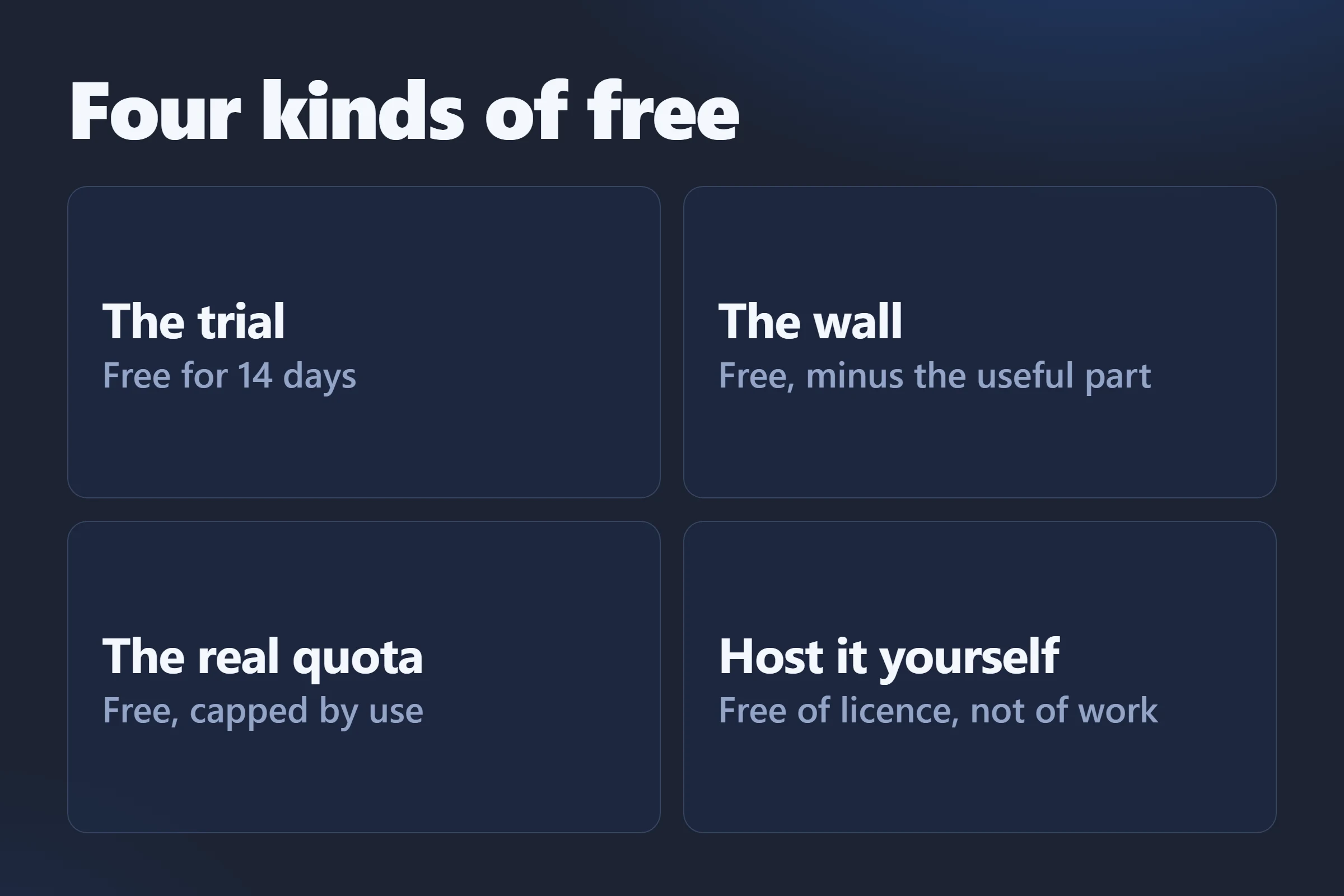
The trial. Free for seven or fourteen days, then it bills. This is not a free plan, it is a deferred bill with a card taken up front, and the giveaway is that it asks for the card before it does anything. A trial is a perfectly reasonable thing to offer. Calling it free is the problem, because the clock starts on the day you install it, which is usually the week you are least able to evaluate it properly.
The free plan with a wall. Free forever, in the sense that the plan never ends, but the thing you actually needed is on the other side of a paywall. The wall is rarely on the number of chats. It is usually on one of three things: it will not read your website, so you have to type every answer in by hand; it will not remove the vendor's name from the chat window; or it will not capture a lead, which is the entire point of having it. Worth finding the wall before you install anything, because the plan is free and useless in exactly equal measure.
The free plan with a real quota. Free forever, capped by how much you use it. Nothing is removed, the meter is simply small. This is the honest shape, and it is the only one of the four where the free version is the same product as the paid version.
The one you host yourself. Open source, free of licence cost, not free. You need somewhere to run it, and you pay the model provider directly for every answer it generates and every page it reads. You are also the person who fixes it when it breaks, and it will break on a Saturday. For a developer this is a genuinely good option. For a business owner who wanted a chat window on their website, it is a project, and it is the reason so many of those Google suggestions point at code.
Why free and AI pull against each other
It helps to know why a free AI chatbot is capped when a free contact form is not.
Every answer costs the vendor real money. The assistant reads your pages once and turns them into something searchable, which has a bill attached. Then each time a customer asks something, it searches your material and sends the relevant passages to a language model to write the reply, and that has a bill attached too. It is small per answer and it is not zero, and it never becomes zero no matter how many customers a vendor has.
That is the whole reason the shapes above exist. A free chatbot from ten years ago was a decision tree, which cost nothing to run and could be given away without limit. An AI assistant cannot be, so every vendor has to choose where to put the limit. Some put it in time, some in features, some in volume.
Which means the useful question is never "is there a free plan". It is what is the meter, and what happens when it runs out. A vendor offering unlimited free AI is either about to stop, or is quietly relying on you never using it.
Five things to check before you call a plan free
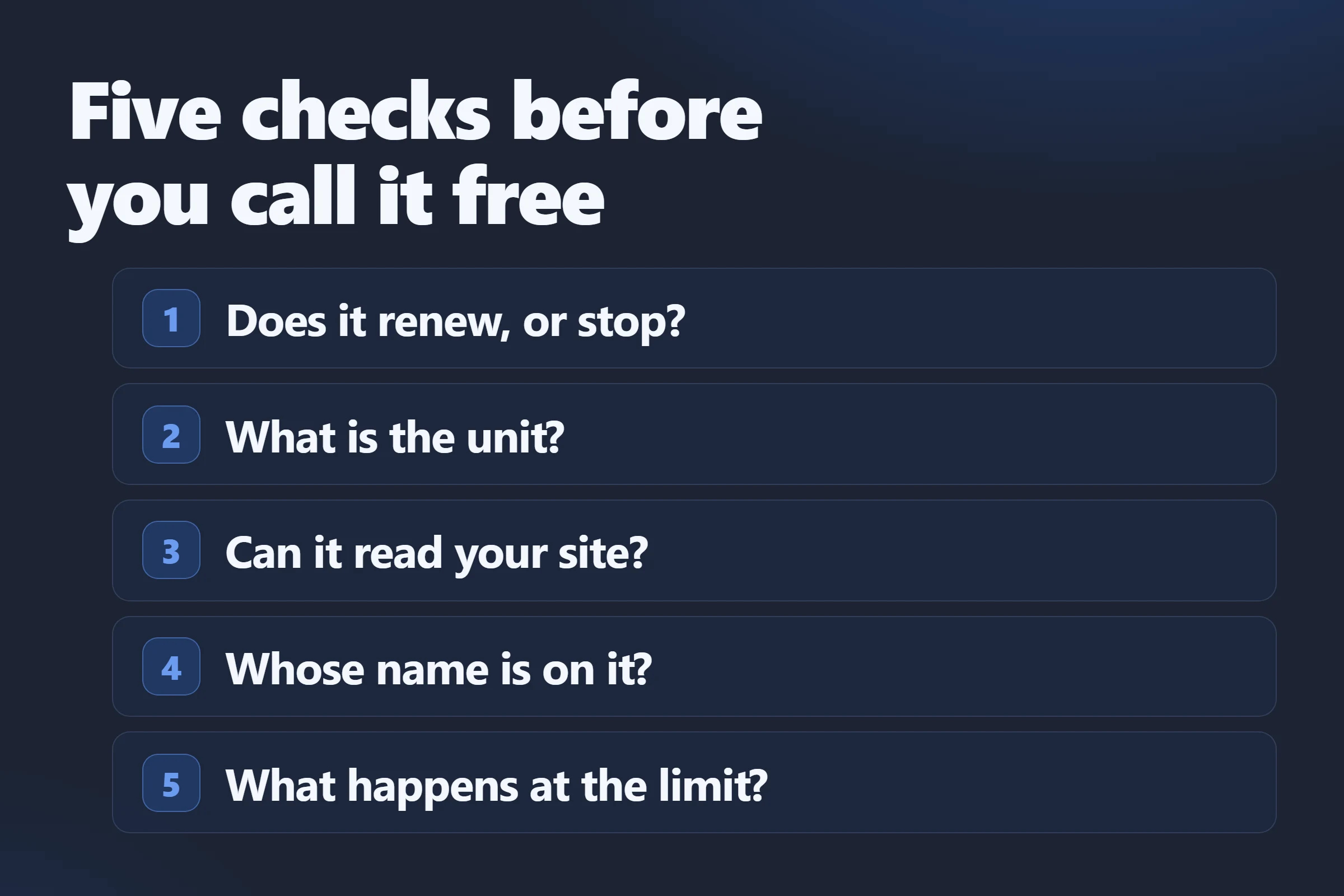
1. Does it renew, or does it stop? A plan renews every month. A trial stops. If the page says free and the signup asks for a card, it is a trial, whatever the heading says.
2. What is the unit, and what is the number? This is where most comparisons go wrong, because vendors count different things. One free plan of 100 might mean a hundred conversations, another a hundred messages, another a hundred replies from the assistant. A single customer sorting out one question can easily send six messages, so a hundred messages is closer to fifteen or twenty customers than a hundred. Find the unit before you compare the numbers, and read the same unit across every product you are looking at. The four billing models are worth understanding properly before you sign anything, free or not.
3. Can it read your website on the free plan? This is the wall that catches most people. An assistant that cannot read your pages is a form with a personality: you have to write every question and answer yourself, which is the work you were trying to avoid. Check specifically that ingesting a website is included in free, and how many pages.
4. Whose name is on the chat window? Many free plans carry the vendor's badge, and on a business website that badge reads as a statement about the business. If you are a designer putting this on a client's site, find out on day one what removing it costs.
5. What happens when you hit the limit? There are only two honest answers, and they are very different. Either it stops answering until the month resets, or it charges you. A free plan that quietly bills when you go over is not a free plan, it is a card on file with a low starting rate. Neither is wrong, but you should know which one you agreed to before a busy month arrives.
What a free AI chatbot can genuinely do
Set against all that, a real free plan does more than people expect, and it is worth being specific about who it is enough for.
It reads your website and answers from it, at any hour, in your own words rather than generic ones. It says plainly when it does not know something instead of inventing an answer, and it takes a name and a number so the enquiry is not lost. It shows you the questions it could not answer, which after two weeks is a list of everything your website does not say, written by real customers.
The thing free cannot do is volume. On Sublex Chat's own free plan, as of 5 September 2026, that means 25 conversations a month, one assistant, and one website of up to 25 pages, at no cost and with no card. A conversation is one visitor's sitting rather than one message, so 25 is roughly one customer a day.
That is genuinely enough for three kinds of business. A small site with a few hundred visitors a month, where one enquiry a day is the real rate. Anyone who wants to run it on their actual website with actual customers for a month before deciding, which is a far better test than a demo. And a designer checking how it behaves on a client's site before proposing it to them.
It is not enough for a busy shop, a hotel in season, or anything with steady traffic. That is the point of the cap, and it is better to know where you sit than to find out in the middle of a good week.
Where free stops, and what comes next
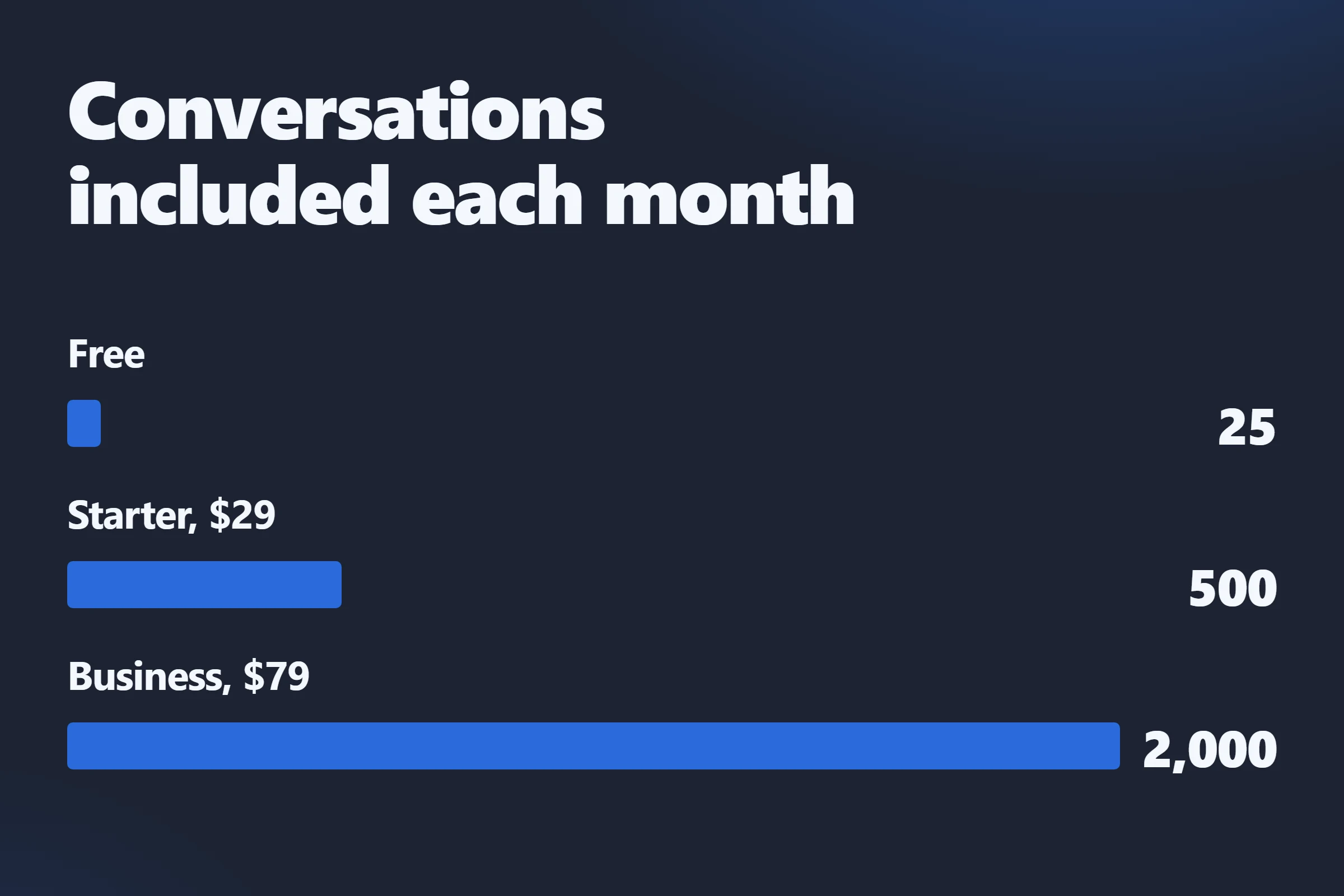
Being straight about this is more useful than a free plan that hides it. These are Sublex Chat's own prices, current on 5 September 2026, and they are on its pricing page rather than behind a form.
Free is 25 conversations a month. Starter is 500 conversations for $29 a month, with two assistants and two seats. Business is 2,000 conversations for $79 a month, with five assistants, three seats and the badge removed. There is a yearly price on both that works out lower.
Two details matter more than the headline numbers. A conversation is counted as one visitor's sitting, and only when the assistant actually answered, so a bot that gets opened and closed does not spend your quota. And going over does not trigger a charge you did not choose: a top-up is something you buy deliberately, 250 conversations for $15 on Starter or 500 for $20 on Business, rather than something that happens to you at 2am.
If your month is seasonal, that shape is worth understanding, because paying for a bigger plan all year to cover August is a common and expensive mistake.
The two free plans that cost the most
Worth naming the two traps specifically, because both are easy to walk into and both cost more than the subscription you were avoiding.
The one that bills automatically at the limit. A free plan with a card attached and no cap is a bill waiting for your best month. If a product will not tell you plainly what happens at the limit, assume it charges, and go and look for the setting that turns that off before you install it.
The one that answers when it should not. This is the expensive one, and it has nothing to do with money until it does. A free assistant that invents a delivery charge, a refund window or an opening time has cost you a customer, and possibly the argument that follows. Free changes nothing about that risk, and a cheaper product is not the place to relax about it. There are five checks worth running on any assistant before it goes near a live site, and they take about ten minutes.
Frequently asked questions
Is there a genuinely free AI chatbot for a website? Yes, but check which of the four kinds it is. A real free plan renews rather than expiring, reads your website rather than making you type the answers, and tells you what happens when the quota runs out. Sublex Chat's free plan is 25 conversations a month with no card, on one website of up to 25 pages, as of 5 September 2026.
How many conversations is enough for a small business? Look at your own numbers rather than a benchmark. Take the enquiries you already get by email, phone and messaging in a month, and roughly double it, because an assistant is asked things nobody would pick up a phone for. A quiet local business is often under 25 a month. A shop or a hotel in season is not.
Does free mean my data is the payment? Ask, and get it in writing. The specific question is whether your conversations are used to train the vendor's models. It is a one-line answer for any vendor who has decided, and a long pause from any vendor who has not.
Can I use a free AI chatbot on a client's website? Technically usually yes, but check whose name is on the chat window first. A vendor badge on a client's site is a statement about that client's business, and the cost of removing it is often the real price of the plan.
What is the catch with the open source ones? No licence fee, but you provide the server, you pay the model provider for every answer, and you are the person who fixes it when it stops. That is a fair trade for a developer and a poor one for a business owner who wanted a chat window.
Will a free plan let me test it properly? Better than a demo will. A demo is a vendor's own site answering questions a vendor chose. A free plan on your own website, with your own pages and your own customers, for a month, tells you what you actually need to know: how often it declines, what it gets asked, and what your site does not say.
Where to start
Do this before you compare any products. Write down the three questions your customers ask most, and one question your website genuinely does not answer.
Then put those four to whatever you are considering, on a free plan, on your own site. The first three tell you whether it can read your material. The fourth tells you what it does when it cannot, which is the answer that actually matters and the one no pricing page will give you.
Sublex Chat's free plan and what sits above it are on the pricing page, and there is a working assistant to try on a demonstration site built from that business's own pages and nothing else.
See Sublex Chat answer from your own website
Give your web address and watch it read your pages, then answer questions about your business. No account needed.