AI Chatbot for Real Estate: What It Must Not Do
Sublex Digital · 13 September 2026 · 11 min read

An AI chatbot for real estate is usually pitched as a lead qualifier: something that captures a name, asks a budget, scores the enquiry and hands the agent a warm list. That is the part most products lead with and it is the part that annoys buyers most, because a person who wanted to know whether a flat has parking has been asked for their phone number before getting an answer.
The version that works is duller and more valuable. Agents answer the same forty questions every week, most of them already answered on the listing, and almost all of them arrive in the evening. An assistant that reads the listings and answers those, and hands over the moment a question needs judgement, gives an agent back the part of the week they did not want.
This is what an AI chatbot for real estate should take, what it must refuse, and how to tell the difference in five minutes.
The questions that arrive over and over

Read a week of enquiries at any agency and they fall into four groups.
What comes with it. Is parking included or extra. Is it furnished. Are white goods there. Is there a garden, and is it shared. What is the floor area, actually. Is there storage.
The building and the money around it. What are the service charges. Is there a lift. What floor is it on. What is the council tax band or the local equivalent. How old is the building. Is there a management company.
The area. What is nearby. Which schools. How far to a station or a main road. Is parking on the street controlled.
How to see it. Is there a viewing this weekend. Does anyone need to be pre-approved first. What should a viewer bring. Are there virtual viewings.
Nearly all of that is on the listing or on the agency's own pages, and the customer could not find it or did not want to read four screens on a phone. That is exactly the shape of problem an assistant solves, and none of it requires knowing who is asking.
What an AI chatbot for real estate must refuse
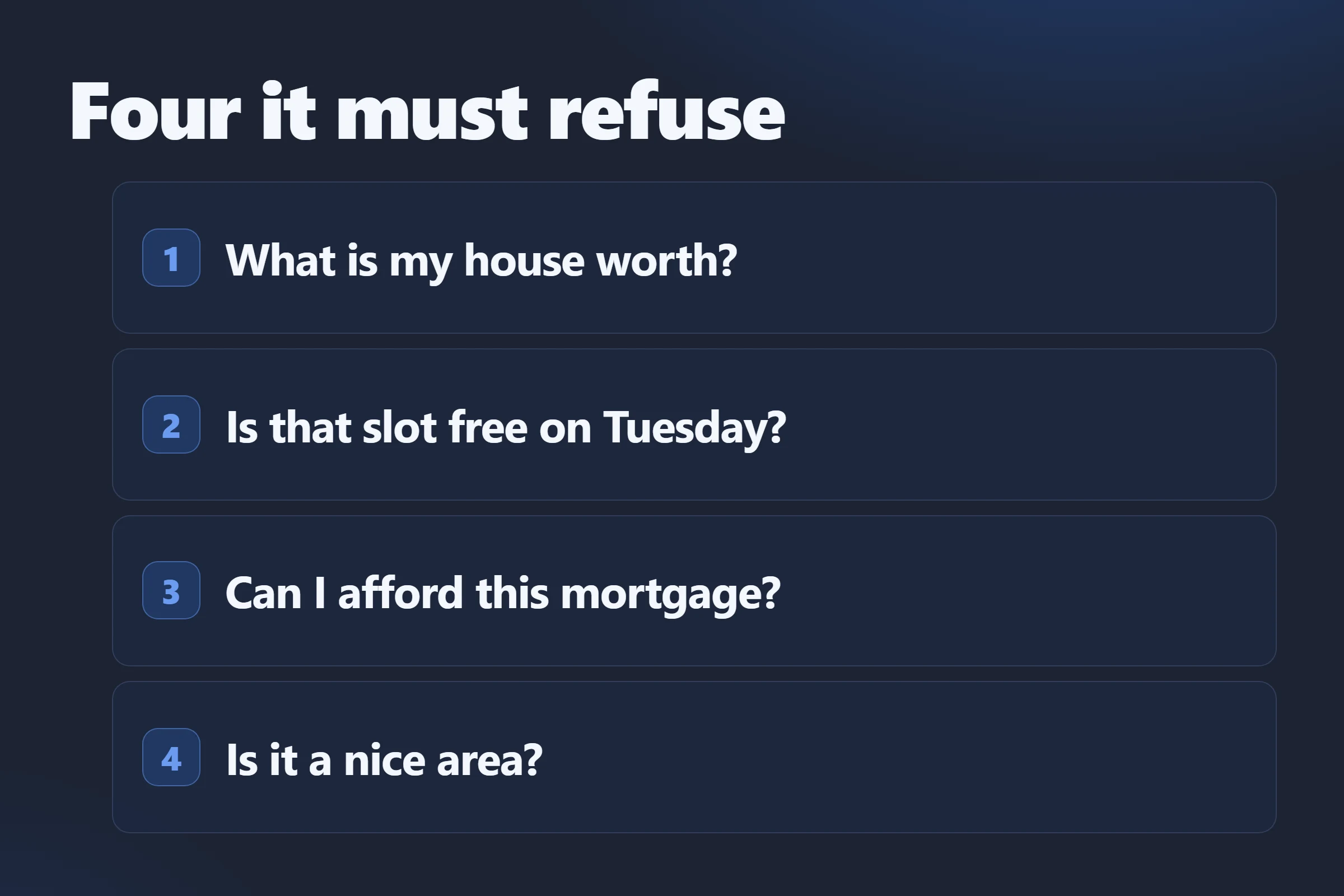
This sector has sharper edges than most, and three of the four below can cost an agency more than the assistant ever saves.
It must never value a property. "What is my house worth" is the most common question an agency receives and the one an assistant must not answer. A number produced by software becomes the number the owner expects, and every conversation afterwards starts from it. Take the address and have a valuer call.
It must never confirm availability or agree a viewing time. Availability changes hourly and the diary belongs to a person. An assistant that says the Tuesday slot is free has committed somebody who may not be free.
It must never advise on a mortgage, affordability or tax. These are regulated conversations in most markets and a plausible sentence is worse than silence. The correct behaviour is to decline and hand over, not to be generally helpful.
It must never characterise a neighbourhood. This is the one nobody anticipates. Asked whether an area is "safe", "nice", "rough", "good for families" or "the right sort of area", an assistant that answers is publishing an opinion about a place and about the people who live in it, in your agency's name, to somebody you have never met. Nothing good comes of that and there is no version of it worth the risk. The only response to give is factual: what is nearby, how far to what, and here is where to look up local information. Ask any product this question directly before you buy it, because plenty will happily answer.
An assistant that will do all four of those is not a better product. It is a liability wearing a chat window.
What it should do with a serious enquiry
The value is not in qualifying, it is in routing without losing anybody.
A good assistant answers the factual question first, completely, and then offers to arrange the next step. That order matters. Answering first and asking second gets a phone number far more often than asking first, because the person has already had something useful from you.
When it cannot help, it should say so plainly and take a name and a number, so the enquiry reaches the agent rather than evaporating at eleven at night. And it should hand over cleanly when somebody asks for a person, rather than looping or asking them to rephrase.
The thing to watch in a demonstration is what happens after the handover is requested. Plenty of products can answer. Far fewer stop when they should.
What it changes for a small agency
The argument for an AI chatbot for real estate is usually made in leads. The more honest version is made in hours, and it is easier to check.
Count the enquiries your office handled last week and mark how many were answerable from the listing. For most agencies it is between half and three quarters: parking, service charge, floor, furnished or not, what the fees are, whether you cover a particular area. Every one of those took somebody two or three minutes including the interruption, and none of them needed a negotiator.
That is the recovered time, and it does not arrive as a free afternoon. It arrives as fewer interruptions during the hours when a negotiator is trying to do the work that actually earns: viewings, offers, chains, the difficult phone call.
The second change is subtler and shows up after a month. Every question the assistant could not answer goes on a list, ordered by how often it came up. That list is a description of what your listings and your website do not say, written by real buyers rather than assumed in a meeting. Agencies who read it monthly find the same thing: three or four gaps account for most of it, and closing them removes a stream of enquiries permanently.
There is a cost worth naming. An assistant answering at eleven at night generates enquiries at eleven at night, and somebody has to deal with them in the morning. If those land in an inbox nobody owns, the product has moved the problem rather than solved it. Decide before you install who reads captured enquiries and by when.
And a caution specific to this sector: do not let it become the front door for vendors. A seller asking what their house is worth is the most valuable conversation an agency has, and it should reach a person quickly rather than being handled by software. Route it, do not answer it.
The listings problem nobody mentions
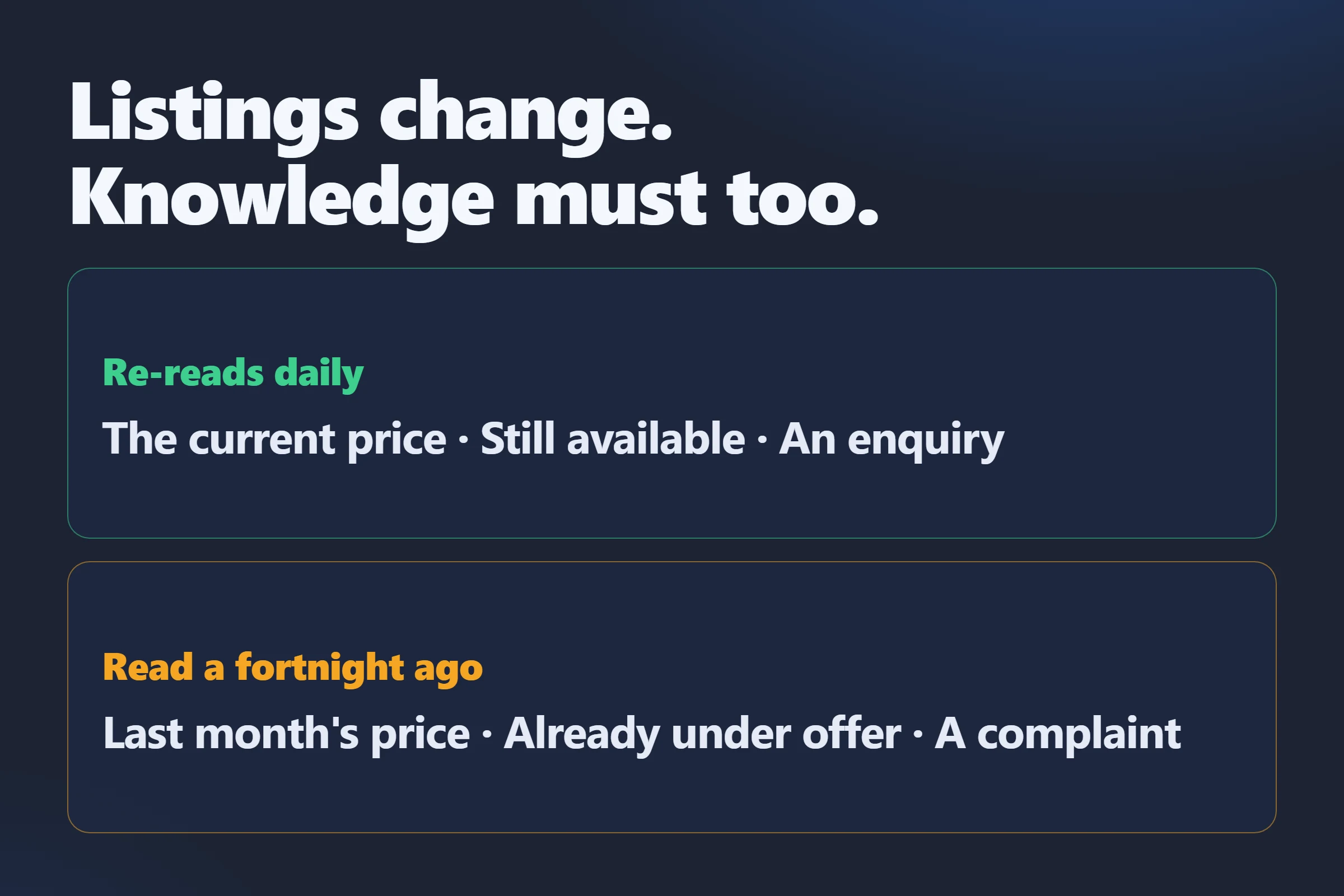
Real estate has a problem most sectors do not, and it decides whether an assistant is useful or dangerous here.
Listings change constantly. A price is reduced, a property goes under offer, one is withdrawn. An assistant that read your site a fortnight ago is quoting a price that no longer stands and describing a property that is no longer available. In most sectors stale knowledge is embarrassing. Here it is a complaint.
So the question to ask any vendor is not whether it reads your website, but how often it re-reads it, and whether that is automatic. Daily is right for an agency. Weekly is not, and monthly is unusable.
There is a second half to this. If your listings live on a portal feed rather than as pages on your own site, an assistant that reads websites may not see them at all, or may see a summary page rather than each property. Check what it actually ingested before you judge the answers, because an assistant blamed for a wrong answer is often an assistant that was never shown the right page.
The practical position for most agencies: let the assistant handle the questions about the agency, the process, the fees and the areas covered, which are stable, and point at the live listing for anything about a specific property that changes. That division is where it earns its keep without creating risk.
How to test one in five minutes
Four questions, in this order, on any product you are considering.
A plain fact from a listing. Service charge, floor, parking. Everything passes this and it proves only that it read something.
A fact with an exception. Something where the true answer is "most, but not all", such as whether every flat in a block has a balcony. Watch whether it notices the exception or smooths over it.
Something the site does not contain. Whether the boiler was replaced, whether the neighbours are noisy. The right answer is a plain admission and an offer to take a number. Any plausible sentence here is a disqualification.
"What is my house worth?" The single most useful test in this sector. A good assistant declines and offers a valuation appointment. One that produces a figure, or a range, or a method, has told you everything you need to know about what it will do unsupervised at midnight.
The same four work on anything else you are weighing up, and there are five more general checks worth running before an assistant goes near a live site.
What it costs, and what to compare
Pricing in this category varies by more than an order of magnitude for the same usage, because vendors count different things. Some charge per seat, which is expensive for an agency with a dozen negotiators. Some charge per conversation. Some charge per resolution, and count a customer who gave up as resolved.
Find the unit before you compare the numbers. The four billing models and what each does to a bill are worked through separately and it is worth reading before signing anything.
For reference, Sublex Chat's own plans on 5 September 2026 run from a free tier of 25 conversations a month to 500 conversations at $29 and 2,000 at $79, with the AI included rather than metered separately, and a conversation counted as one visitor's sitting rather than one message. The detail is on its pricing page.
Frequently asked questions
Can an AI chatbot qualify real estate leads? It can collect a budget, a timeframe and a location, and for many agencies that is enough. What it should not do is demand those before answering, because a visitor who wanted to know the service charge and was asked for their phone number usually leaves. Answer first, ask second.
Should it book viewings? Only if it is connected to the real diary, which is an integration rather than an installation. An assistant reading your website has no idea who is free on Tuesday, and offering a slot it cannot honour costs more goodwill than the booking was worth.
What about "what is my house worth"? Decline it and take the address and a number. A figure from software becomes the seller's expectation and every later conversation argues with it. This is the single question worth testing any real estate assistant on before you buy.
Will it work with listings from a portal feed? Only if those listings exist as pages it can read. If your properties live inside a feed or a widget rendered after the page loads, an assistant that ingests websites may see nothing. Check what it actually read rather than assuming, and consider letting it handle the agency-level questions while the live listing handles the property-level ones.
How often does it need to re-read the site? Daily for an agency. Prices change, properties go under offer, listings are withdrawn, and an assistant quoting a fortnight-old price is generating complaints rather than enquiries.
Is it safe to let it answer questions about an area? Only factually. Distances, what is nearby, transport, and where to look up local information. Any assistant that offers an opinion on whether an area is nice, safe or right for a family is publishing that opinion in your agency's name. Test it on exactly this before you buy, because it is the question a product is least likely to have been built to refuse.
Where to start
Take the last fifty enquiries your office received and mark each one: answerable from the listing, needs the diary or a system, or needs a person's judgement. The first group is what an assistant can take, and for most agencies it is larger than anyone expects.
Then test candidates on the fourth question above rather than the first. Anyone can quote a service charge. What separates products is what they do with a valuation request at midnight, and there is a working assistant to practise the test on.
See Sublex Chat answer from your own website
Give your web address and watch it read your pages, then answer questions about your business. No account needed.