AI Chatbot for Hotels: What Guests Actually Ask
Sublex Digital · 20 September 2026 · 11 min read
An AI chatbot for hotels is usually sold as a way to take bookings. That is the one job it should not do, and selling it that way is why so many hotels try one, find it useless, and take it off again.
The useful job is smaller and worth far more. Almost every question a guest asks before booking is already answered somewhere on the hotel's own website. It is spread over the rates page, the room descriptions, the directions page and a policies page nobody has read since it was written. A guest at eleven at night is not going to find it. They will send a message instead, and then wait until morning, and some of them will book somewhere that answered.
An assistant closes that gap. It reads the pages the hotel already has and answers from them, at any hour, in one message, and it hands over to a person the moment the question stops being about information.
The questions guests actually ask
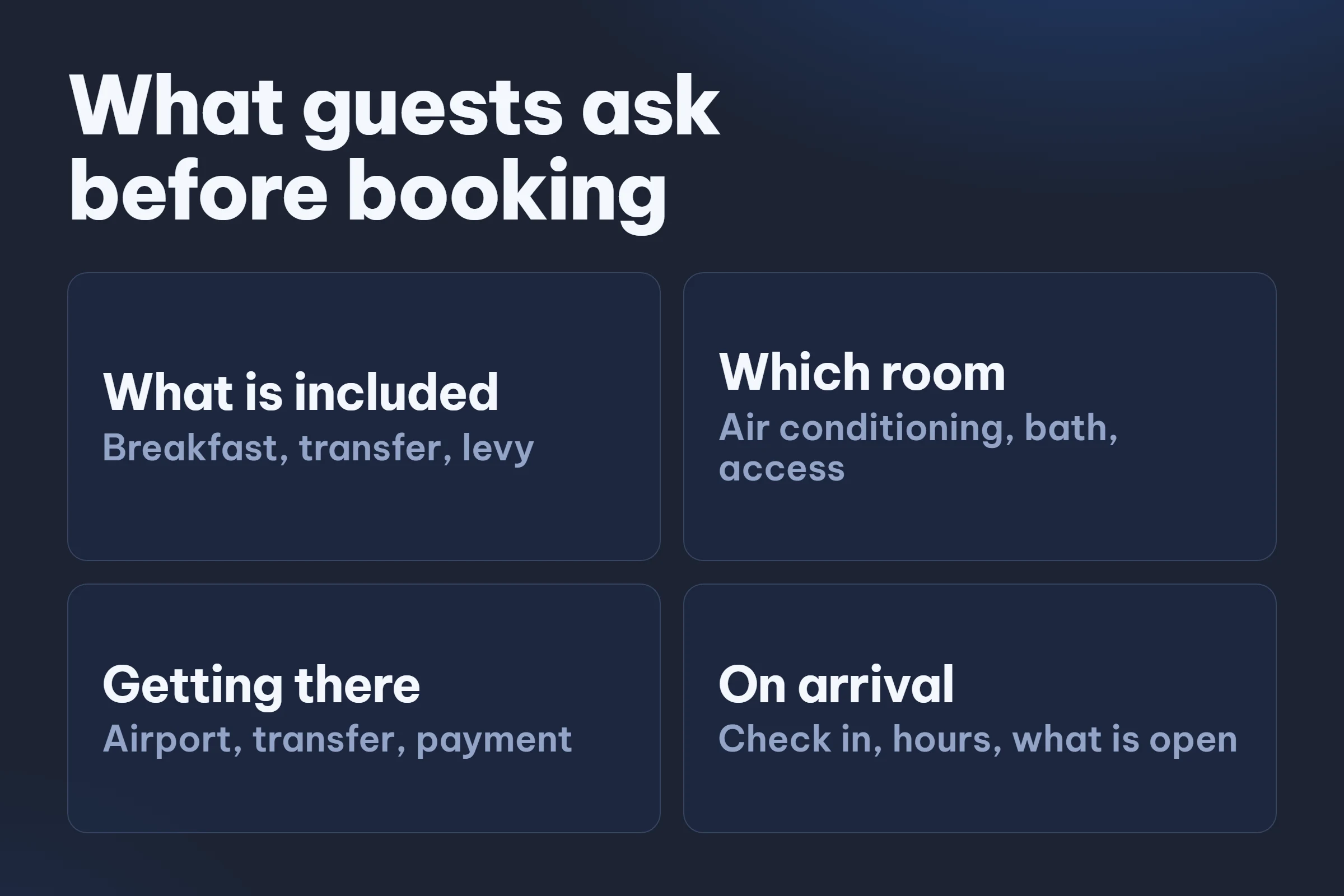
Read a week of enquiries at any small hotel and the same shapes come round. They fall into four groups.
What is actually included. Is breakfast in that price. Is the airport transfer included or extra. Is the tourism levy on top. Does the rate cover two people or one. Are towels and loungers by the pool included or hired. This is the largest group by a distance, and it is the one that decides whether a rate looks expensive or fair.
Which room, specifically. Does every room have air conditioning. Is there a bath or only a shower. Is there a ground floor room. Is there a connecting room for children. Do any of them have a kitchenette. Is the balcony facing the sea or the car park.
Getting there and getting about. How far from the airport, how long does it take, is the transfer at any hour, do you take card or cash, do you accept the local currency, is there parking.
What happens on arrival. What time is check in, can bags be left before it, is the restaurant open on a Sunday, what time does the pool close, is the spa open in low season, can a treatment be booked in advance.
Very little of this is a booking question. It is all reading, and the reading is on the site already.
Why the hotel's own website does not answer them
Hotel websites are organised the way a hotel thinks. Rooms on one page, rates on another, what is included in a paragraph on a third, and the policies at the bottom of a fourth.
A guest does not ask in that shape. A single question crosses three pages at once: "can we get a ground floor sea view room for two adults and a child, and does the price include the transfer from the airport?" To answer that from the website a guest has to read the room list, work out which types are on the ground floor, check occupancy, and then find the inclusions paragraph on a different page. Almost nobody does. They send a message.
The booking engine does not help either, because a booking engine answers one question, which is whether a room is free on a date. It has nothing to say about whether the bungalows are air conditioned or whether the spa opens on a Sunday.
So the questions land in an inbox or on a phone, they arrive in the evening, and the hotel answers them one at a time, forever.
What an AI chatbot for hotels must never do
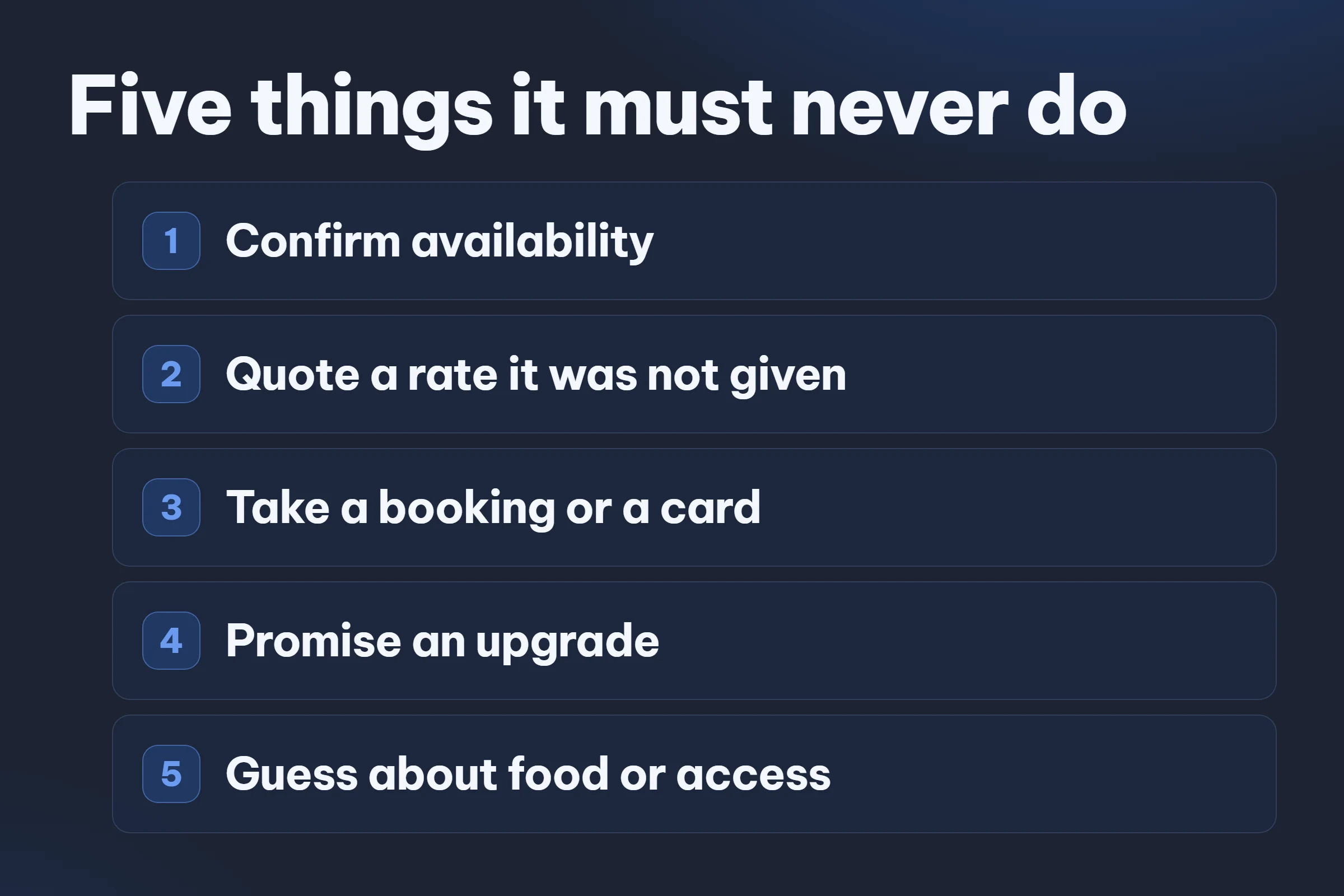
This is the part that decides whether the assistant is an asset or a liability, and it is worth being firm about before anyone installs anything.
It must never confirm availability. Availability lives in the booking system, it changes by the minute, and an assistant that says "yes, we have a sea view room that week" has made a promise on behalf of a hotel that may not be able to keep it. The honest answer is to point at the booking page or take the dates and pass them to reception.
It must never quote a rate it was not given. Rates move by season, by length of stay, and by whatever is agreed on the phone. An assistant should quote only what is published on the hotel's own pages, say plainly what the figure is and what season it applies to, and stop there.
It must never take a booking, a deposit or a card number. A chat window is not a payment page and should never pretend to be one.
It must never promise an upgrade, a late checkout or an early check in. Those are decisions a duty manager makes on the day, based on what is in the building. An assistant that offers one has cost the hotel either the money or the goodwill.
It must never guess about food, allergies or accessibility. These are the questions where a confident wrong answer does real harm. If the hotel has not written down whether the kitchen can do a gluten-free breakfast, the right response is to say so and take a number.
An assistant that will do all five of those things is not more helpful. It is a member of staff who says yes to everything and never writes it down.
The single question that separates a good assistant from a bad one
Take a real example from the demonstration hotel used to show this working, a beachfront resort with sixty eight rooms of four types. Three of those types have air conditioning. The six beach bungalows have ceiling fans and the sea breeze instead, which is a deliberate choice and part of why people book them.
A guest asks: "do all the rooms have air conditioning?"
The plausible wrong answer is "yes, all our rooms are air conditioned." It sounds right. It matches most of the building. A general-purpose chatbot produces it readily, because it is the sort of sentence that fits the shape of a hotel. It is also the answer that puts a family in a bungalow in April expecting air conditioning, and it ends in a refund.
The correct answer requires actually reading the room list and noticing the exception. That is the whole test of an AI chatbot for hotels, and it is worth running on any product before it goes near a live site: ask it something where the true answer is "most, but not all", and see whether it notices.
An assistant that answers only from the hotel's material, and declines when the material does not cover it, gets this right because it has no other source to generalise from. One built to sound helpful gets it wrong, confidently, at two in the morning, to somebody who will not check.
What to feed it
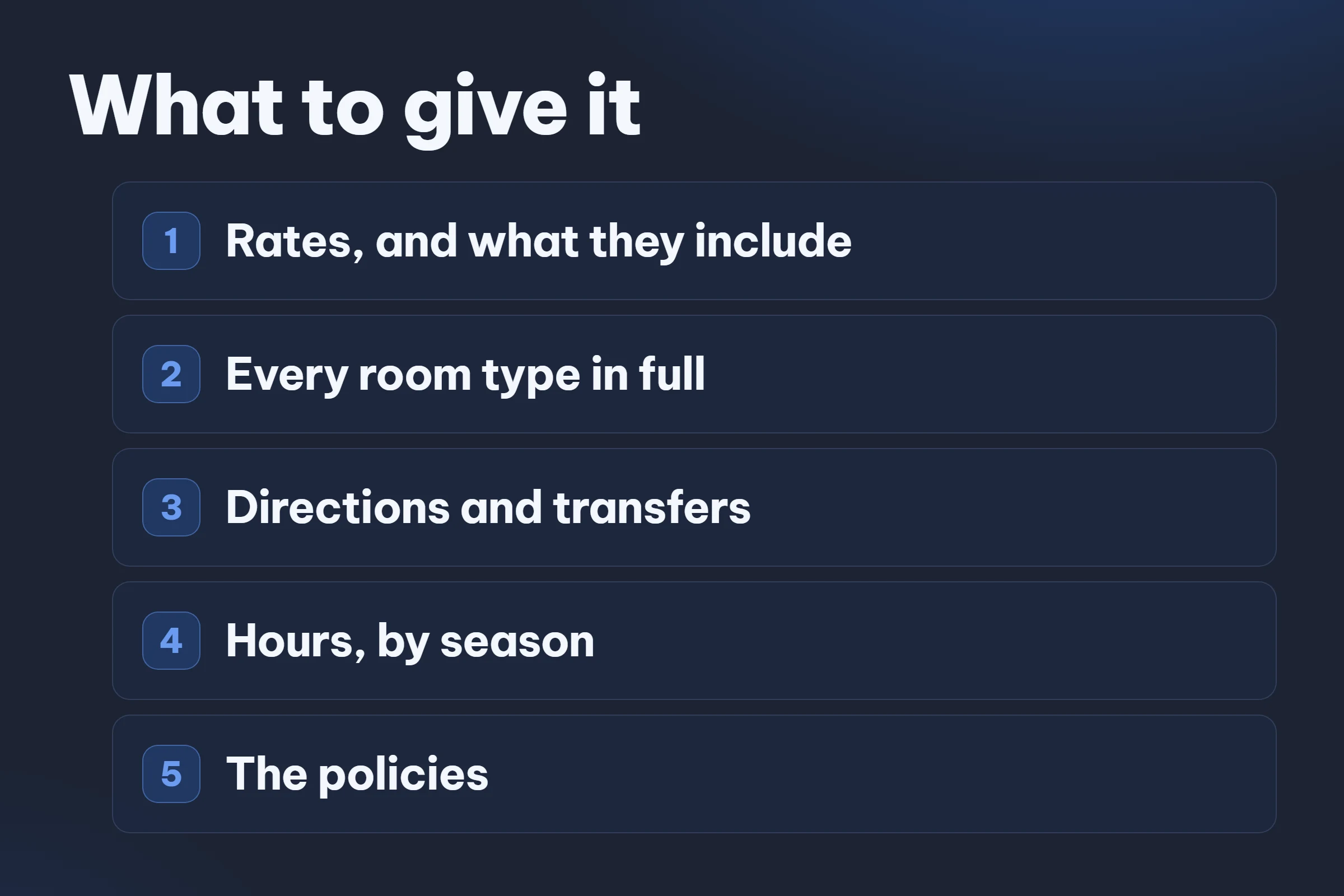
Setting one up is mostly a matter of pointing it at the site and then noticing what the site does not say.
Give it the rates page and, importantly, the paragraph that says what a rate includes. Give it every room type in full, with the exceptions written out rather than implied. Give it directions, transfer arrangements and what payment is accepted. Give it opening hours for the restaurant, the pool and the spa, including what changes in low season. Give it the policies on children, cancellation, pets and smoking.
Then look for the four things most hotel websites are missing, because they are the four that generate the most messages:
What exactly is in the rate, itemised rather than summarised. Which rooms are step free, and what step free means at that hotel. What happens between arriving early and checking in. And what is open, and what is not, in the quiet months.
Writing those four down is worth doing even if no assistant is ever installed. With one installed, it is the difference between an assistant that answers most questions and one that answers nearly all of them.
The questions it cannot answer are the valuable ones
The output most hotels underuse is the list of questions the assistant could not answer.
Every one of those is a guest who wanted something the website does not contain, written in their own words, at the moment they wanted it. After two weeks a hotel has a ranked list of everything missing from its own site, gathered from real guests rather than guessed at in a meeting.
Answering them once fixes the website and the assistant at the same time, and the list gets shorter every month. This is the part that keeps paying after the novelty of the chat window has worn off, and it is the reason to look at the dashboard once a month rather than never.
See one running before you buy one
Reading about this is less useful than trying it. There is a demonstration hotel at demo1.sublexchat.com with a working assistant on it, built from that hotel's own pages and nothing else.
Ask it what the rate includes. Ask it whether every room has air conditioning. Then ask it something the site does not cover, such as whether the kitchen can do a birthday cake, and watch what it does with a question it has no answer to. That last one is the test worth running on any assistant, and it takes about thirty seconds.
The same test applies to whatever else you are considering. There are five checks worth running before trusting one on a live site, and the cost of getting it wrong shows up in the pricing only after it has already shown up in a refund.
Frequently asked questions
Can an AI chatbot take hotel bookings? It should not, and a hotel is better off if it does not. Availability and payment belong in the booking engine, which is built for both. The assistant's job is everything around the booking: what the rate includes, which room suits, how to get there, what is open. Its handover should be a link to the booking page or a person, not an attempt to do it in a chat window.
Will it work in more than one language? It should, since guests arrive from several countries and most will type in their own language. Sublex Chat sets the chat window's language per assistant, in English, French, Arabic or Spanish, with right to left layout where the language needs it.
What happens when a guest asks something the website does not cover? The right behaviour is to say plainly that it does not have that information, offer to take a name and a number, and add the question to the list the hotel sees. The wrong behaviour is a plausible sentence, and it is worth testing for specifically rather than assuming.
How long does it take to set up for a hotel? About fifteen minutes for the assistant itself. Give it the web address, let it read the pages, add any documents such as a menu or a rate card, then install the WordPress plugin or paste one line into any other site. The longer job, and the one worth doing properly, is writing down the four things the site does not currently say.
Does it replace the front desk? No, and a hotel that sells it that way to its own staff will get resistance it does not need. It takes the repeated reading questions, which are the ones nobody at the desk enjoys answering for the fortieth time, and passes everything else through. The desk gets fewer messages and better ones.
Will guests use it, or do they prefer to call? Guests who are ready to call will still call. The ones it serves are the ones who were never going to: browsing at eleven at night, in another time zone, comparing three hotels, with one question standing between them and a booking. Those enquiries were not being lost visibly. They were not arriving at all.
Where to start
Open your own website and try to answer this as a guest would: what is included in the cheapest room, is it step free, and how do you get there from the airport. Time yourself. If it takes more than a minute, that is the gap, and it is the same gap every guest hits before they message you.
Then try it on the demonstration hotel, ask it the same three things, and see how long it takes there.
See Sublex Chat answer from your own website
Give your web address and watch it read your pages, then answer questions about your business. No account needed.