Chatbot vs AI Chatbot: The Difference That Matters
Sublex Digital · 17 September 2026 · 11 min read
Chatbot vs AI chatbot sounds like a distinction invented to sell the second one. It is not. They are genuinely different machines, they fail in opposite directions, and the one that suits you depends on a question about your own business rather than on which is newer.
The short version of chatbot vs AI chatbot: one follows a script somebody wrote, the other writes a sentence. Everything that matters follows from that, including which one will still be working in a year.
What a chatbot actually is
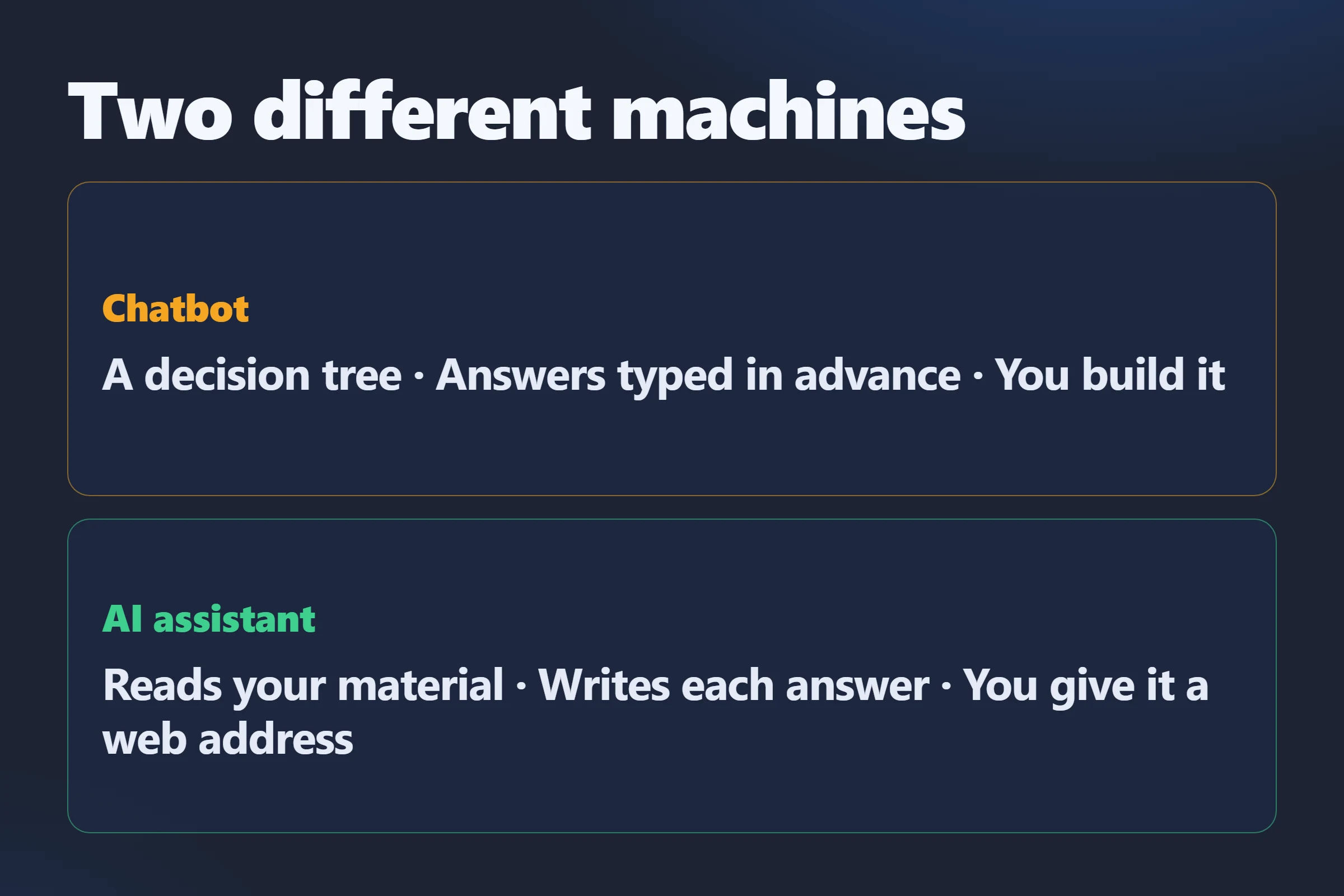
The classic chatbot is a decision tree. Somebody sits down and maps it out: if the visitor picks "Opening hours", show this text. If they pick "Delivery", ask which area, then branch three ways.
Every answer in it was typed by a person in advance. Nothing is generated, nothing is inferred, and it cannot say anything nobody anticipated.
That produces a very specific set of properties. It is completely predictable, which is why banks and airlines still use them for the paths that must never vary. It costs almost nothing to run. It never invents anything, because it has nothing to invent with.
And it is unbearable to maintain. Every change to your business is a change to the tree. New service, new branch. Changed price, find every node that mentions it. Six months in, nobody remembers how it fits together, and the person who built it has moved on.
The visitor experience has one failure mode and everybody has met it: a set of buttons, none of which is your question, and no way to type. The bot is not broken. Your question was simply not one of the ones somebody thought of.
What an AI chatbot actually is
An AI chatbot does not hold answers. It holds your material, and when a question arrives it searches that material, takes the passages that look relevant, and asks a language model to write a reply using them.
Nobody typed the answer. It is composed each time, which is why it can handle a question phrased in a way nobody anticipated, and why two people asking the same thing get slightly different wording.
The properties invert. Nothing to build, because it reads what you already have. Nothing to maintain when your business changes, because you change the page and it reads the page. It handles the long tail, which is most of what people actually ask.
And it has the failure mode a decision tree cannot have: it can produce a fluent, confident sentence that is not true. The mechanism that lets it answer an unanticipated question is the same mechanism that lets it invent a delivery charge.
That is the whole trade, and it is worth stating plainly rather than selling around.
Chatbot vs AI chatbot: the two failure modes
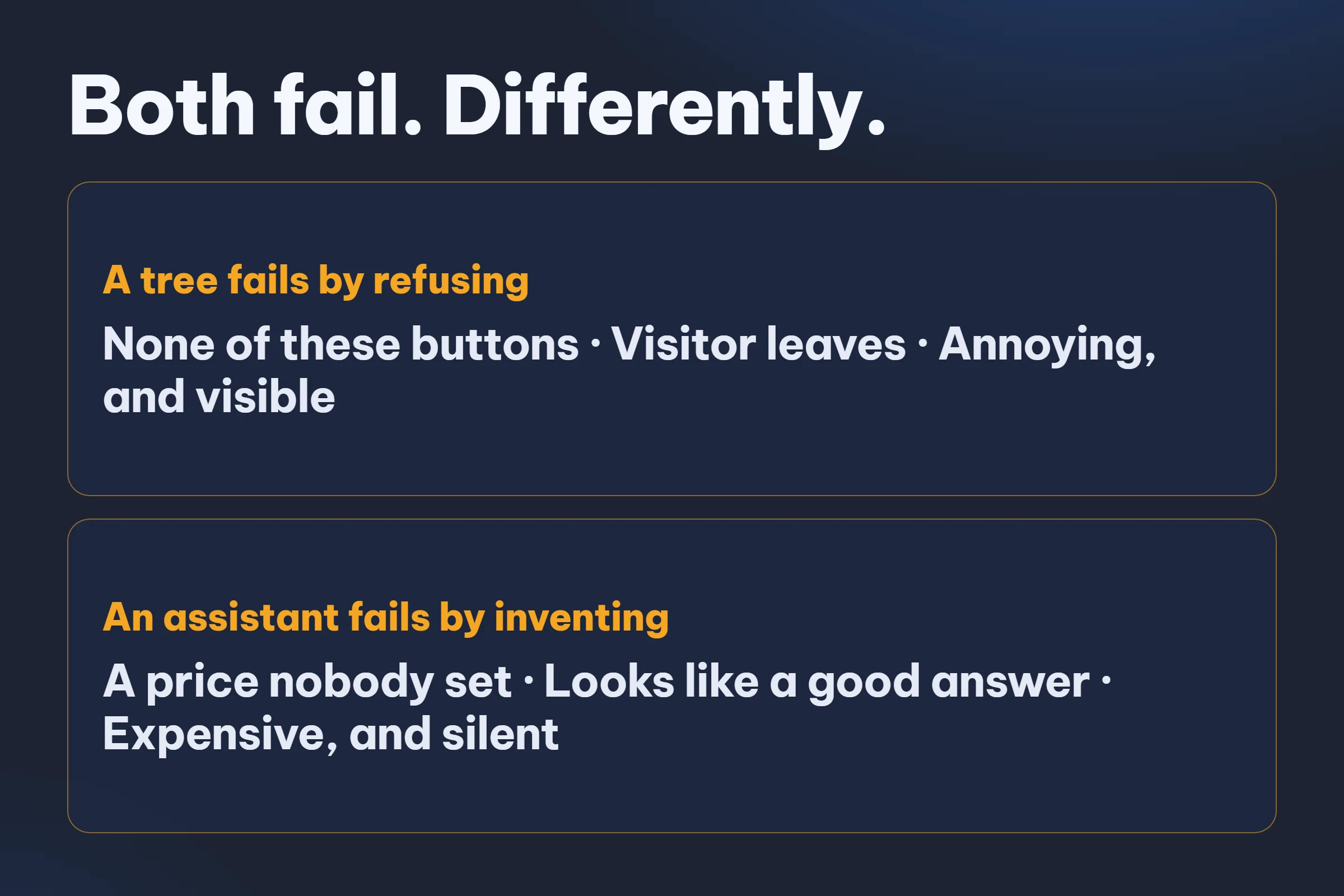
A chatbot fails by not answering. The visitor sees buttons, none of them fits, and they leave or ask for a person. Irritating, visible, and it costs you the enquiry.
An AI chatbot fails by answering. It produces something plausible that nobody at your business ever said. Invisible, because it looks exactly like a good answer, and you find out when somebody arrives expecting a price that was never offered.
The first failure is annoying. The second is expensive, and it is worse for being silent: there is no complaint, no error, nothing in a log that says a wrong answer went out at half past eleven.
Which is why the sensible question about an AI chatbot is never "how much can it answer". It is what it does with the questions it should not. There are five checks that take about ten minutes and settle it.
Why chatbot vs AI chatbot became a real question
For about fifteen years there was no question to ask. Every chatbot was a decision tree, the word meant one thing, and businesses that tried one came away with the same impression: a box of buttons that never had their question in it.
That impression is still what most people bring to this. When a small business owner says they do not want a chatbot, they usually mean they do not want that, and they are right not to.
What changed is not that trees got smarter. It is that a second, unrelated machine arrived and inherited the same word. A language model can compose a sentence it was never given, which means the answer no longer has to exist in advance. That single property removes the thing everybody hated, and introduces a new thing to worry about.
So chatbot vs AI chatbot is not a spectrum from worse to better. It is two designs with opposite strengths that happen to share a name, and the shared name is the reason so many buying decisions go wrong. Somebody who was burned by a decision tree in 2019 refuses an assistant that would have worked, and somebody expecting an assistant buys a tree and discovers they have signed up to maintain it.
One more thing the history explains: why "trained on your data" is such a common phrase and such a poor guide. On a tree it meant somebody typed your answers in. On an assistant it can mean it reads your website, or that your content sits in a searchable index, or occasionally that a model was actually adjusted on your text, which is rare and usually unnecessary. Ask what happens mechanically rather than accepting the phrase.
The middle thing most products actually are
Worth knowing, because a lot of what is sold as AI is this.
Many products bolt a language model onto a decision tree. The tree still runs and still needs building, and the model is used to work out which branch a typed question belongs to, or to reword a scripted answer so it sounds less robotic.
That is a legitimate design. It is also the one that gets the maintenance cost of a chatbot and the invention risk of an assistant at the same time, and it is worth knowing which you are being sold.
The tell is the demonstration. If setting it up involves dragging boxes onto a canvas and drawing lines between them, you are buying a tree, whatever the page calls it. If setting it up is giving it a web address, you are buying an assistant.
Neither answer is wrong. Buying one while believing you bought the other is the problem, because you will have budgeted for the wrong kind of work.
Which one suits you
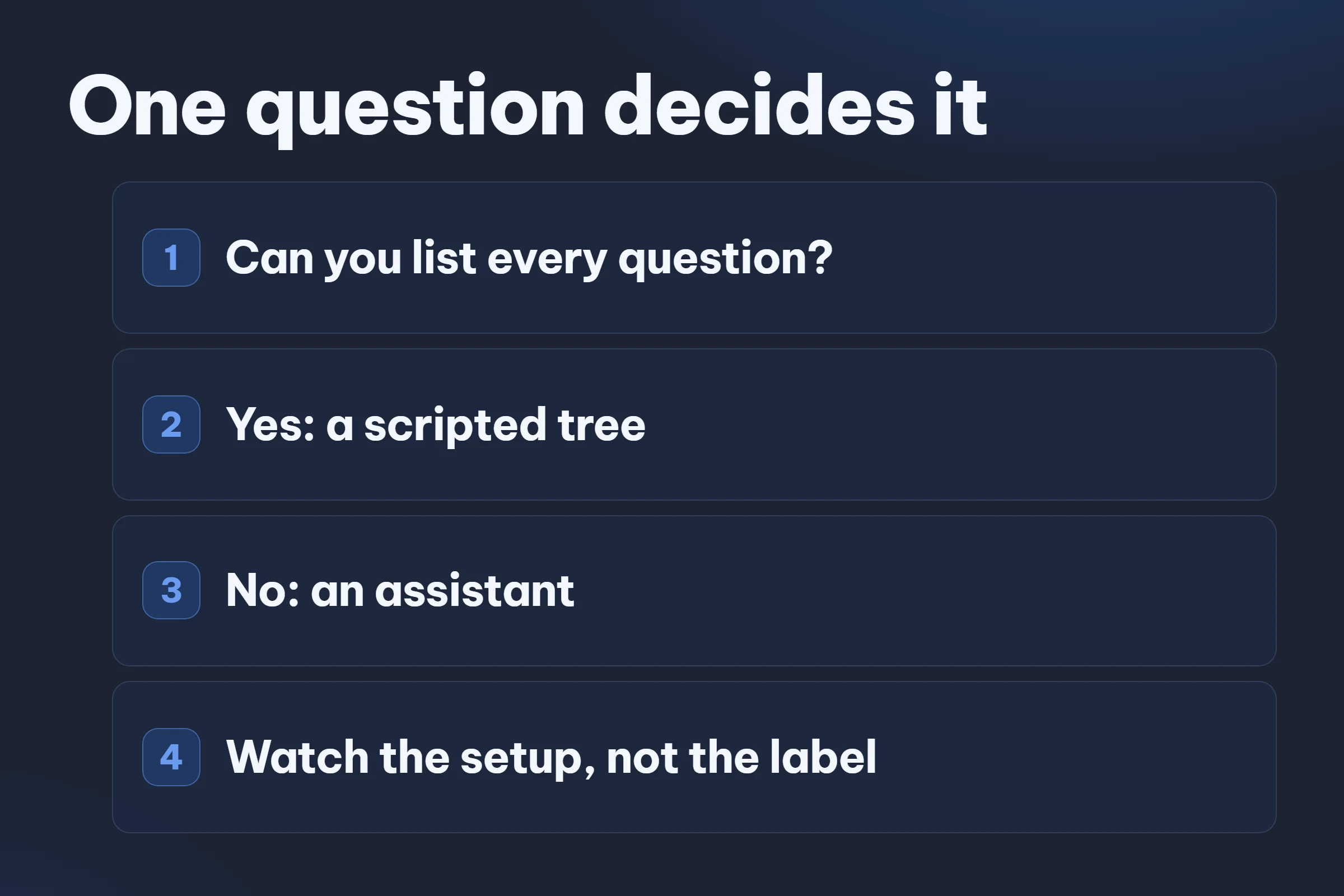
For all the noise around chatbot vs AI chatbot, one question decides it: can you write down every question a visitor might ask?
If you can, a scripted bot is genuinely the better tool, and anybody telling you otherwise is selling. A tracked order lookup, a returns start, a booking flow with four steps: these are fixed paths where variation is a bug, and a decision tree does them perfectly and cheaply. Regulated processes belong here too, because a scripted answer is an answer somebody signed off.
If you cannot, and almost no small business can, then a tree will always be missing the question that just arrived. What is in a price. Whether you cover a particular village. Whether the thing works with the other thing. Those are unlimited in shape, they are already answered somewhere on your website, and reading is exactly what an assistant does.
Most small businesses have a handful of the first and a very long tail of the second. That is why the honest answer for most is an assistant that reads their material, with a firm rule about declining, rather than a tree.
What to ask a vendor either way
Four questions, and they settle chatbot vs AI chatbot whichever one you are being shown.
How is it set up? A web address, or a canvas. This tells you which machine it is regardless of the marketing.
What happens to a question that was not anticipated? A tree should hand over to a person. An assistant should say it does not know and take a number. Anything else from either is the wrong answer.
Who maintains it, and how often? A tree needs somebody every time the business changes. An assistant needs somebody to re-read the missed questions once a month. Both need an owner, and a tool nobody owns stops being true within a quarter.
What does it do when the business changes? Ask specifically how often it re-reads your site, and whether that is automatic. A price changed in March and quoted in June is the same failure in either machine.
Where the cost difference actually is
Not where people expect.
A scripted chatbot is cheap to run and expensive in time. The licence may be free, and then somebody spends two days building the tree and half a day a month keeping it right. That labour is invisible in a budget and it is the real price.
An AI chatbot costs money per answer, because every reply involves a model call, which is why free plans in this category are capped by usage rather than by a clock. In exchange, the setup is fifteen minutes and the maintenance is reading a list once a month.
For a business paying somebody's time, the assistant is usually cheaper in the round, even though it has a monthly bill and the tree did not. The four billing models are worth understanding before comparing any two products, because the same usage produces wildly different bills depending on what is being counted.
Frequently asked questions
Is an AI chatbot better than a regular chatbot? Better at different things. A scripted bot is better on a fixed path that must never vary, and cheaper to run. An assistant is better at questions nobody anticipated, which for most small businesses is nearly all of them. The deciding question is whether you can list every question in advance.
Can I have both? Yes, and several products do it: a scripted path for the two or three flows that must be exact, and an assistant for everything else. It is more to set up and more to maintain, and it is worth it only if you genuinely have a fixed process that matters.
Do AI chatbots still make things up? They can, and it is the failure mode of the design rather than a bug in one product. What differs is whether the product was built to prevent it. An assistant restricted to your own material and required to decline anything else behaves very differently from one asked to be helpful with the whole of a model's general knowledge behind it.
Which is cheaper? The tree is cheaper per month and more expensive in somebody's time, because it needs rebuilding whenever the business changes. The assistant has a monthly bill and almost no maintenance. Count the hours before deciding which is cheaper for you.
How do I tell which one I am being sold? Watch the setup. Dragging boxes and drawing lines is a decision tree. Typing a web address is an assistant. The word on the pricing page tells you nothing.
I already have a scripted chatbot. Is switching a big job? Usually smaller than building the tree was. An assistant reads your website rather than importing your tree, so most of what you built does not transfer and does not need to. The work is checking your site actually contains the answers the tree held, because plenty of those were typed into the builder and exist nowhere else. Export or screenshot the tree before you cancel anything.
Are rule-based chatbots obsolete? No, and that claim is usually made by somebody selling the other thing. They remain the right answer for fixed, repeatable, regulated paths where a predictable answer matters more than a flexible one.
Where to start
Write down the five questions your customers ask most, and then try to write down the next twenty. If you run out at eight, you have your answer, because the twelve you could not think of are the ones a tree will miss.
Then, whichever you choose, test it on something it cannot possibly know before you put it on your site. That single question tells you more than any comparison, and there is a working assistant to practise it on.
See Sublex Chat answer from your own website
Give your web address and watch it read your pages, then answer questions about your business. No account needed.