AI Chatbot for Small Business: Is It Worth It?
Sublex Digital · 21 September 2026 · 12 min read
An AI chatbot for small business is usually sold on the number of conversations it will handle. That number is the least useful thing about it. A busy one and a useless one can produce the same figure, and neither tells you whether a single extra customer arrived.
What pays for itself is narrower and duller than the sales page suggests, and it is worth knowing before you spend anything.
Two products sold as an AI chatbot for small business
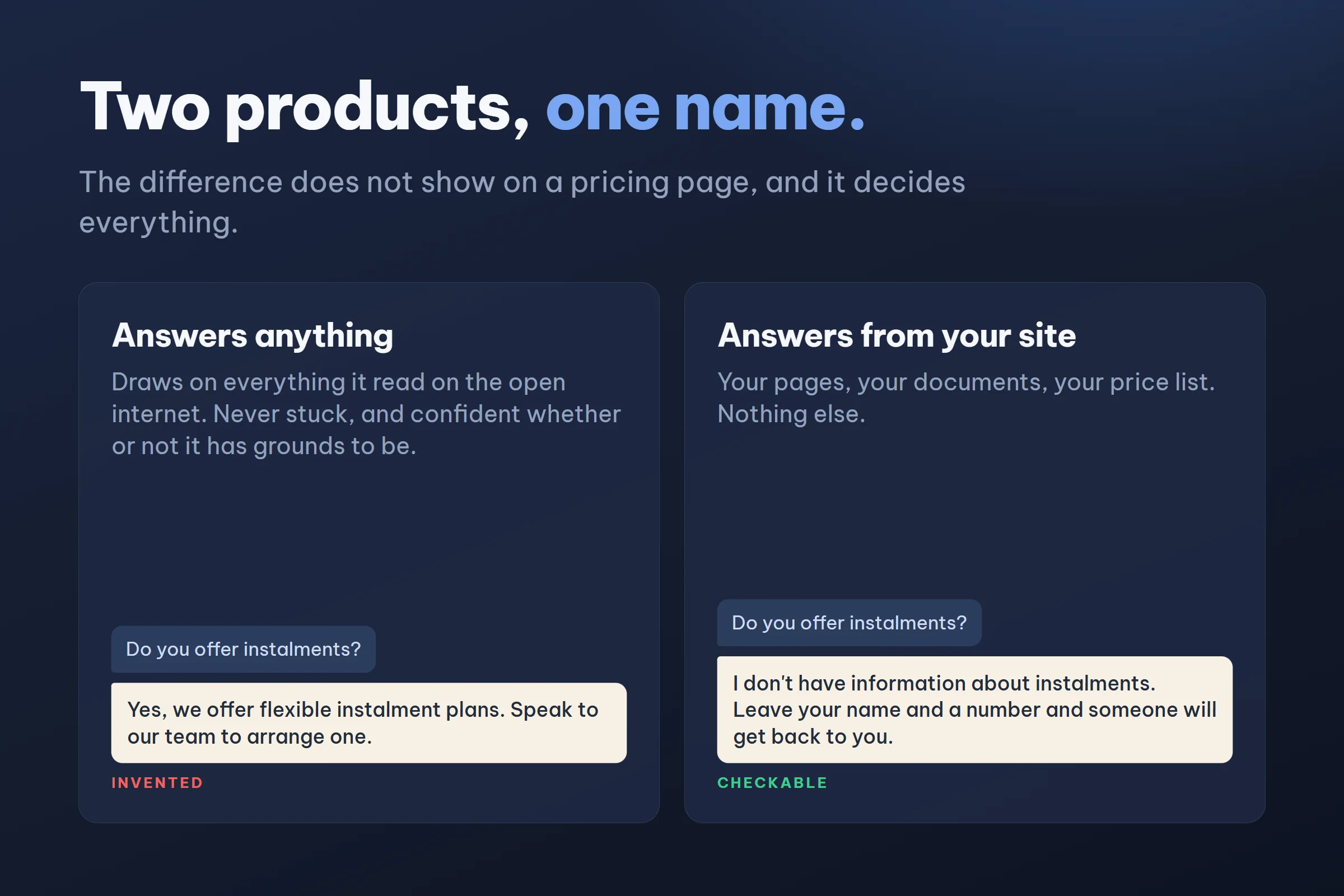
Everything depends on which of these you buy, and the difference is invisible on a pricing page. Both are sold as an AI chatbot for small business and they behave nothing alike.
The first kind will answer anything. It draws on everything it learned from the open internet, so it is never stuck, and it is confident whether or not it has grounds to be. Ask it about instalments and it will tell you about instalments, including at a business that has never offered them.
The second kind can only draw on what you gave it. Your pages, your documents, your price list. When the answer is not in that material it says so, and stops.
For a shop window with a phone number on it, only the second is safe. A made up price is not a saved phone call. It is a phone call you now have to make, to somebody who is already annoyed.
What an AI chatbot for small business actually pays back
The enquiry that arrives when nobody is there
Most enquiries do not arrive during working hours. They arrive in the evening, from somebody comparing three businesses before they go to sleep, and the one that answers first usually gets them.
That is not a staffing problem you can solve by hiring. It is a coverage problem, and coverage is the one thing software is genuinely good at.
The list of questions nobody wrote down
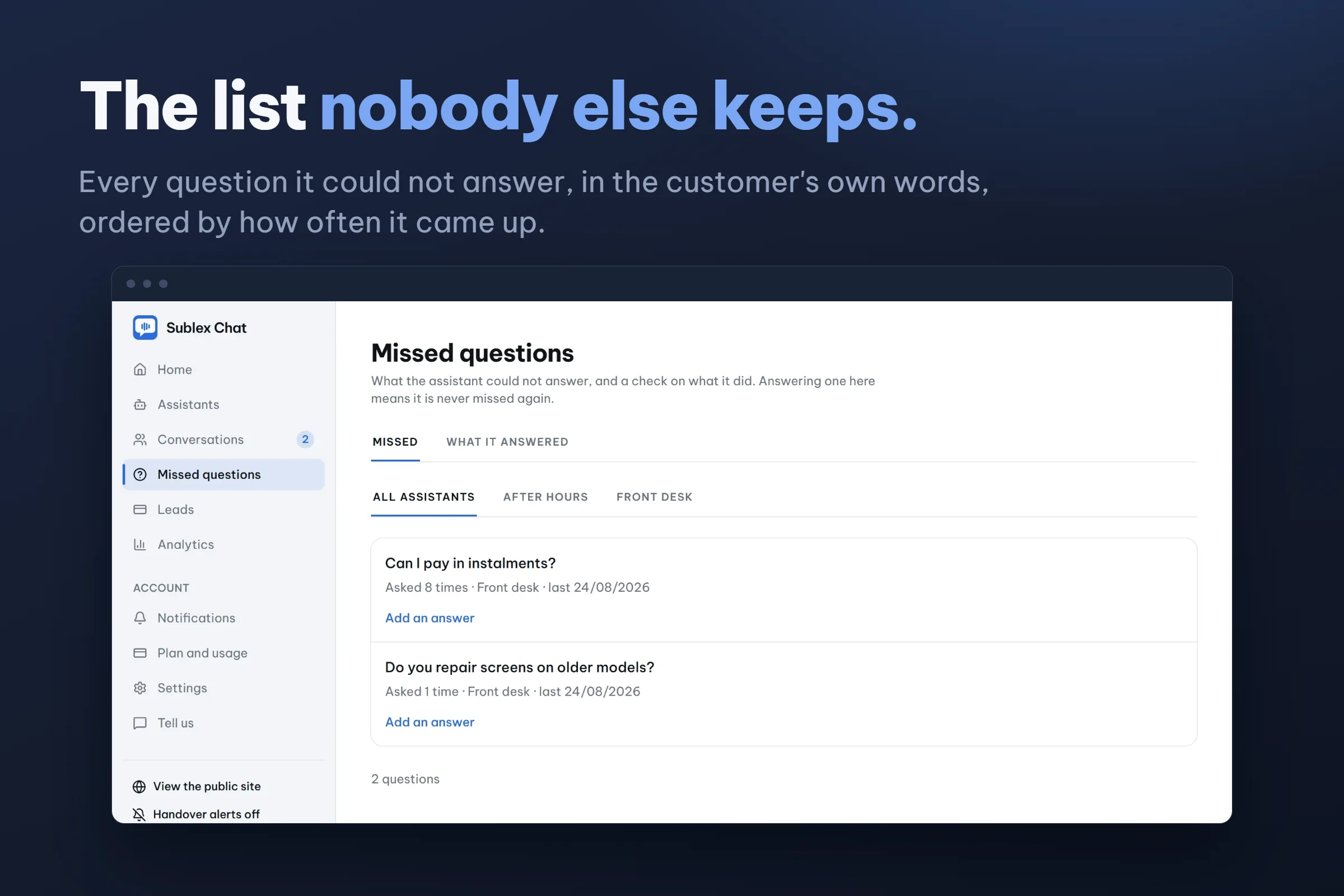
This is the part that surprises owners, and it is the strongest argument for buying one at all.
Every website has holes in it. Not bad writing, just things nobody thought to publish. Whether there are instalments. Whether there is parking. Whether the price includes tax. Customers ask constantly, and almost none of them ask twice.
A good assistant keeps every question it could not answer, in the customer's own words, with a count beside each one. That list is a map of what your website does not say and your customers keep asking for.
On one site, ten people asked about paying in instalments in a single month. Nothing on the site mentioned instalments. Nobody had ever told the owner.
The lead that would otherwise have evaporated
A contact form is a hope. A phone number in a footer is a hope.
When the assistant cannot answer, the right behaviour is to say so rather than invent something, and to ask for a name and a number. The enquiry that would have disappeared becomes a line in an inbox with a way to ring the person back.
What it costs
There are free plans in this category that genuinely work at low volume, and they are a reasonable place to start. Sublex Chat's own plans on 21 September 2026 begin free with 25 conversations a month and no card, then 500 conversations at $29 and 2,000 at $79, with the AI usage included rather than metered on the side.
Three things decide whether a cheap plan is actually cheap:
- Is the AI included, or billed on top? Some plans price the software and then charge for the model calls separately, which is the bill that surprises people.
- What does it cost to remove the supplier's branding? On some products that is the jump from the entry plan to a much larger one.
- Are you billed per message or per conversation? A conversation is four or five messages. The difference between the two is the difference between two prices for the same usage.
There is more detail in what an AI chatbot should cost.
What a free plan actually gets you
Free plans in this category are real, not a trick, but they are free for a reason and it is worth knowing which reason.
The usual limit is conversations, not time. Twenty-five or fifty a month is common. A conversation is one customer and everything they asked, not one message, so twenty-five goes further than it sounds. A quiet site will never reach it. A busy one will hit it in a fortnight.
The supplier's name is usually on the widget. That is the real price of free, and for most small businesses it is a fair trade. For anyone selling on professionalism, a law firm or a private clinic, it is the thing that pushes them to a paid plan first.
Expect fewer assistants and fewer seats. One assistant on one website, one person able to log in. That is fine for a single business and a problem the moment you run two sites or want a colleague to see the enquiries.
What should not be limited is honesty. If a free plan will answer anything and the paid plan is the one that stays inside your own material, that is not a free tier, it is a different product. Check that the behaviour you are buying is the behaviour you get for nothing, and then decide about volume.
The sensible order is to run the free plan for a month, look at how many conversations you actually had and how many questions it could not answer, and let those two numbers decide whether to pay. That is a better basis than any plan comparison table, Sublex Chat's included.
When an AI chatbot for small business is the wrong purchase
Worth saying plainly, because finding out after paying is expensive.
If almost nobody visits your website. This does not create demand, it answers it. Fix the visiting first.
If your prices change daily. An assistant reading an out of date page will quote an out of date price faithfully. That is your website being wrong, and the assistant will simply make it visible faster.
If the thing you need is a person. Complaints, negotiations and anything emotional need a human being. The honest version of this product hands over rather than pretending.
If you want it to take bookings. Be wary of anything claiming to, unless it is genuinely connected to your calendar. Taking a name and a number is the honest version.
What it looks like across five trades
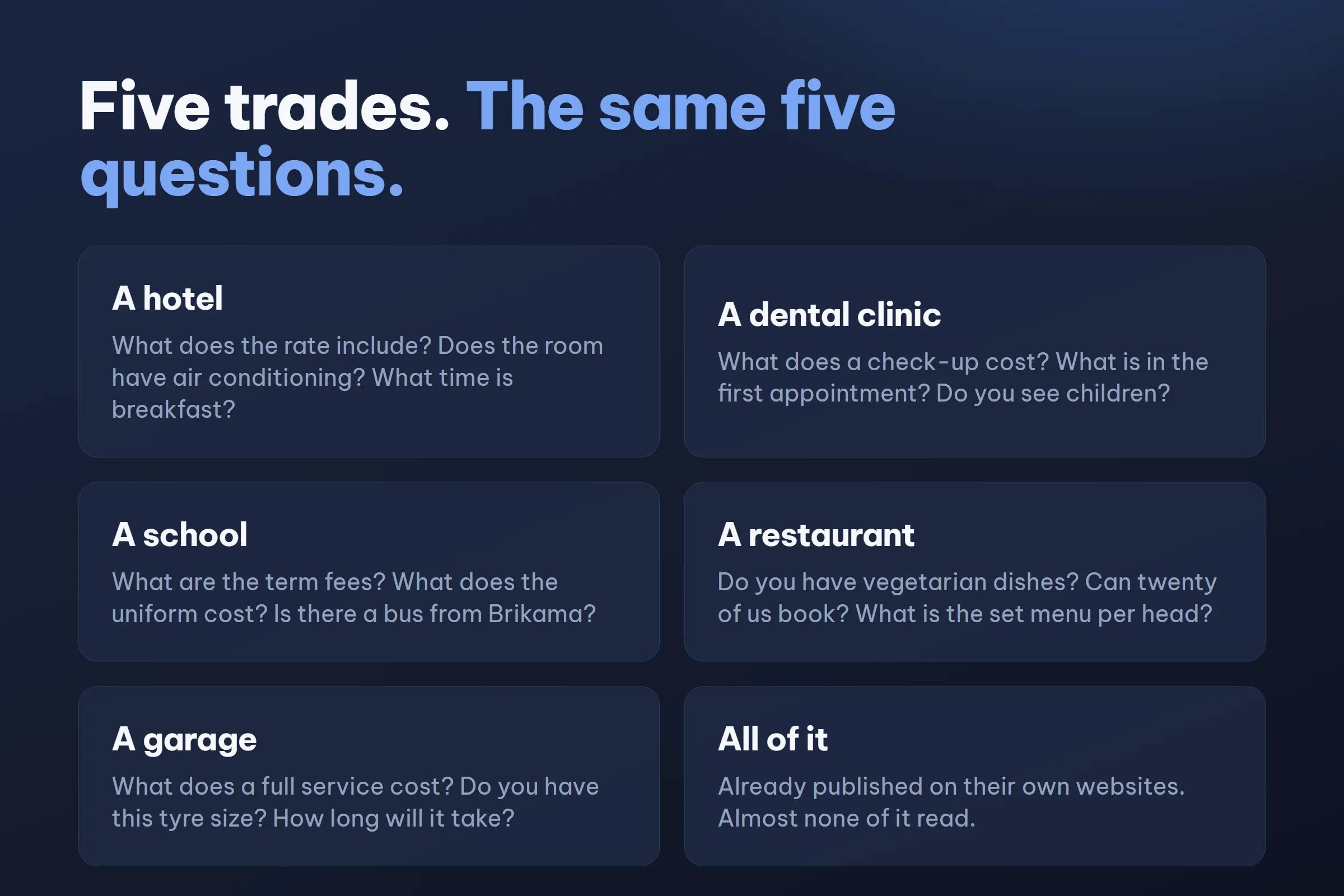
The questions differ by trade far more than people expect. These are real answers from assistants running on live sites.
A hotel gets asked what a rate includes, whether a room has air conditioning, and what time breakfast runs. A dental clinic gets asked what a check-up costs and what the first appointment includes. A school gets asked about term fees, uniform costs and bus routes. A restaurant gets asked whether there are vegetarian dishes and whether twenty people can book. A garage gets asked what a full service costs and whether a tyre size is in stock.
All of it is already published. Almost none of it is read.
What the first month actually looks like
Nobody tells you this part, so expectations about an AI chatbot for small business end up wrong in both directions.
The first week is quiet and slightly disappointing. The assistant answers the easy questions correctly and not many people use it, because most visitors do not notice a new chat button. This is normal and it is not a sign of anything.
The second and third weeks are where the value shows up, and it arrives from the direction you were not looking. The unanswered list starts filling with questions you did not know were being asked. Delivery to a particular town. Whether a deposit is refundable. Whether somebody can come on a Saturday. None of these are on your website, all of them are being asked, and until now every one of those people simply left.
By the fourth week you should have edited your own website twice. That is the real outcome and it is worth saying plainly: the assistant is a diagnostic tool as much as a customer service one. Businesses that treat the unanswered list as a to-do list get several times more out of it than businesses that leave it running and never open the dashboard.
If nothing has changed on your website after a month, either nobody is using the assistant or you are not reading what it tells you. Both are fixable, and neither is the software's fault.
What to give it, and what to leave out
The quality of the answers is decided almost entirely by what it can read, and most people give it too little rather than too much.
Give it the whole website, not just the home page. Service pages, the about page, the contact page with the opening hours on it. If you have a page you are slightly embarrassed by because it is out of date, fix it or remove it, because the assistant will read it and quote it.
Give it the documents nobody reads. The price list in a PDF. The menu. The terms. The rate card. These are usually where the specific answers live, and they are usually the files sitting in a folder rather than on a page.
Write down the things that are true but unpublished. Every business has a handful: which areas you deliver to, whether there is parking, what happens if somebody is late. This is the only part that takes real effort, and it is the part that decides whether the assistant is good or merely fine.
Leave out anything internal. Staff rotas, supplier costs, anything half-written. It will be read and it can be repeated. A useful rule is to only give it things you would be comfortable seeing quoted back to you by a stranger, because that is exactly what will happen.
Leave out pages that are wrong. An assistant reading an out of date page quotes an out of date price with total confidence. That is not a fault in the software. It is your website being wrong faster and louder than before.
How to judge one before you pay
Ignore the demo on the supplier's website. It is tuned. Do this instead.
- Point it at your own site. Anything worth using will let you do that without an account.
- Ask it three questions your site answers well. It should get all three right, quoting your own wording.
- Ask it one question your site does not answer at all. This is the whole test. A grounded assistant will tell you it does not know and ask for a way to reach you. A general one will produce a confident paragraph, and you have just watched it invent something about your business.
- Ask it something slightly wrong. A room type you do not have, a service you stopped offering. See whether it corrects you or plays along.
Step three is the one that separates the two products, and it takes about a minute.
Frequently asked questions
Is an AI chatbot worth it for a small business?
If you answer the same questions repeatedly, and some of them arrive outside working hours, yes. The value is not novelty. It is the enquiries that currently go unanswered at eleven at night and never come back.
How long does it take to set up?
About fifteen minutes for the assistant itself: give it your web address, let it read the site, add any documents, then put it on your site. The longer job, and the one worth doing properly, is writing down the answers that are not currently on your site anywhere.
Do I need a developer?
No. Every major website builder has somewhere to paste a line of code, and on WordPress there is a plugin, so there is no code at all.
What happens when it does not know?
That depends entirely on which product you chose, which is why it is the most important question to ask. A grounded assistant says it does not have that information and takes contact details. A general purpose one will usually produce an answer anyway.
Can I see what it told people?
Yes, and you should. Every conversation is readable in the dashboard. Fifteen minutes a month spent reading real exchanges will tell you more about your customers than any analytics report, and it is how you catch an answer that has quietly gone out of date.
What if my website is small?
A small website is fine. A thin one is not. Five good pages that actually answer questions beat twenty pages of description. If the site does not say what things cost or when you are open, the assistant cannot say it either, and it will tell people so.
Will it slow my site down?
A well built widget loads after the page and adds nothing to how fast the page itself appears. Ask how large the loading script is. Anything under about 10KB, loaded after the page, is fine, and a supplier who cannot tell you the number has told you something anyway.
Sublex Chat is an AI customer support assistant that reads your website, your documents and your price list, and answers customers from those and nothing else. When the answer is not there it says so, and takes the enquiry instead of guessing.
Try it on your own site. Free plan, no card.
See Sublex Chat answer from your own website
Give your web address and watch it read your pages, then answer questions about your business. No account needed.