What Is the Best AI Chatbot? Four Things Decide
Sublex Digital · 6 September 2026 · 11 min read

The best AI chatbot is not a product, it is a match. The same tool that is obviously right for a software company with a large documentation site is obviously wrong for a garage with eleven pages, and no ranked list can tell you which of those you are.
Four questions settle it. They take about ten minutes to answer honestly, and once they are answered the field narrows from dozens of products to two or three, usually without a comparison table being involved at all.
What follows is those four questions, what each one rules in and out, and a plain statement of where the assistant this site sells is the wrong choice. That last part is unusual in an article like this and it is the most useful part of it.
The four things that decide it
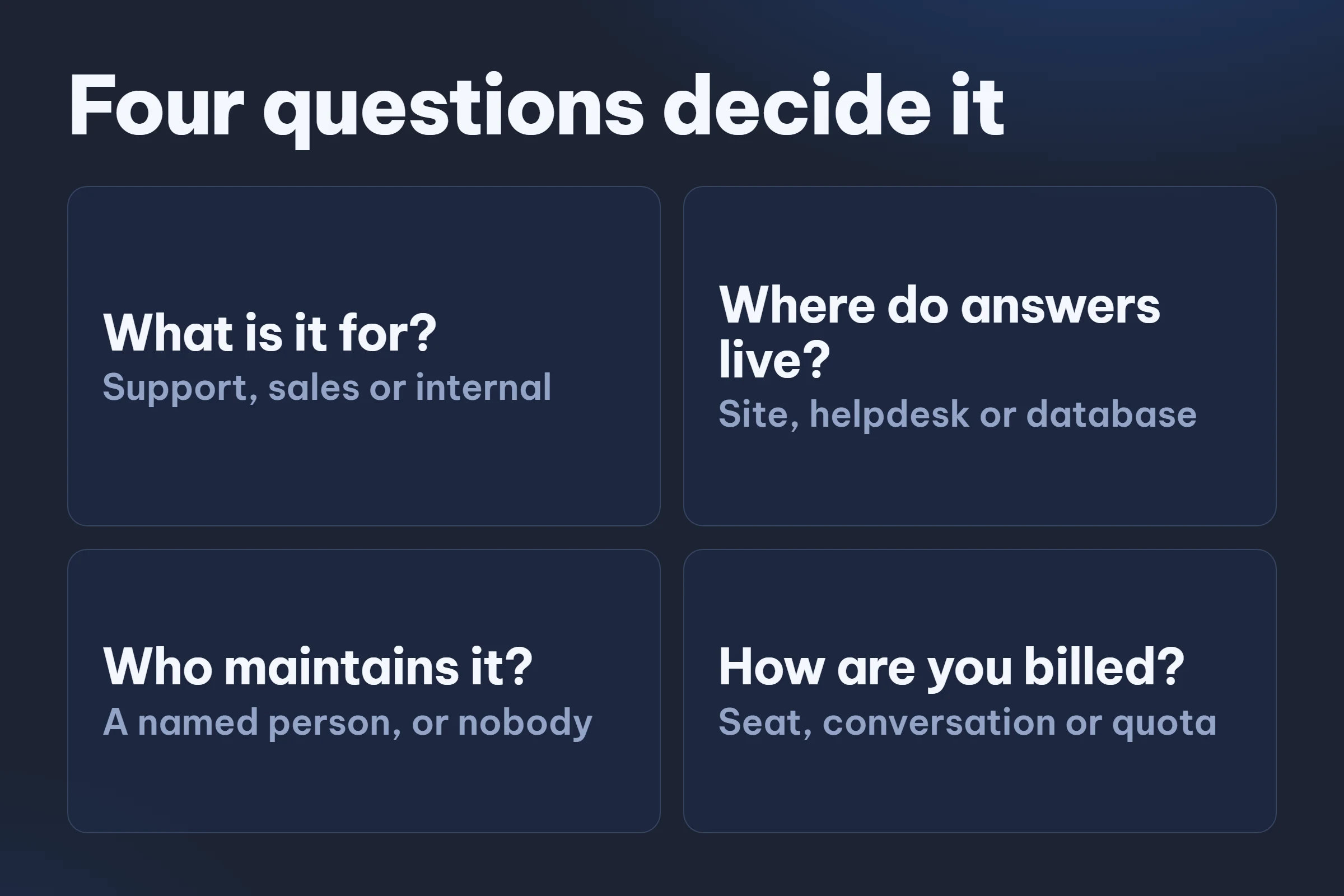
What is it for? Answering customers, selling to them, or serving your own staff internally. These are three different products that share a chat window. An assistant built to answer questions makes a poor salesperson, and a sales bot that qualifies and pushes makes a maddening support agent.
Where do the answers live? On your public website, in a helpdesk full of tickets and articles, in a database of orders and accounts, or in the head of the person who has always answered them. This is the question that actually eliminates most products, and almost nobody asks it first.
Who will maintain it? A named person with an hour a month, or nobody. Products vary enormously in how much attention they need, and a tool that requires flows to be redrawn every time your business changes will be abandoned within a quarter if nobody owns it.
How are you billed? Per seat, per conversation, per resolution, or a flat plan with a quota. The same usage produces wildly different bills across those four, and the model matters more than the headline price.
The best AI chatbot when the answers live on your website
This is most small businesses, and it is the narrowest and easiest case.
Your prices, hours, policies, services and FAQs are on your site. Customers ask about them constantly. Nothing needs to be looked up per person. What you want is something that reads those pages, answers from them, and declines anything else.
What to look for: it ingests a website rather than requiring you to type question and answer pairs; it re-reads on a schedule so it does not go stale; it refuses cleanly and captures a lead when it cannot help; and it shows you what it could not answer.
What to avoid: anything sold on flow building. If the demonstration involves dragging boxes onto a canvas, you are being sold a decision tree with a language model on top, and you will be maintaining that tree forever.
The best AI chatbot for this case is whichever one you can install in an afternoon and forget, and the honest test is not whether it answers but whether it declines. There are five checks worth running before you trust one on a live site.
If the answers live in a helpdesk
If you already run a ticketing system with a knowledge base, agents, queues and service level targets, the calculation is different and mostly not about the assistant at all.
What matters is whether it sits inside the tool your team already works in. An assistant bolted onto the website that cannot see tickets, cannot hand a conversation to the agent who handled the last one, and does not appear in your reporting will create work rather than remove it.
In this case the best AI chatbot is usually the one your helpdesk vendor sells, even if a standalone product looks better in isolation, because the integration is the feature. This is a real case where a small standalone assistant, including this one, is the wrong answer.
If the answers need account data
"Where is my order", "when is my appointment", "has my payment cleared". These need a system that knows who is asking and can look them up.
That is a connected assistant, and it is a build rather than an install: authentication, an integration with the system holding the data, and a decision about what it may reveal to somebody who might not be the account holder. Expect a project, expect a developer, and expect it to be the most expensive option on this page by a distance.
Anything sold as reading your website will not do this, and should say so plainly rather than implying otherwise.
If you have a developer and a specific idea
If somebody on the team writes code and the requirement is unusual, building on a model provider directly is a legitimate answer and is often cheaper at volume.
The trade is the one every self-hosted thing makes. No licence fee, but you provide the hosting, you pay the model provider per answer, and you are the person who fixes it on a Saturday. For a team with a developer and an unusual requirement, worth it. For a business owner who wanted a chat window, it is how six weekends disappear.
If nobody is going to maintain it
The fourth question is the one most likely to be answered dishonestly, and it decides more outcomes than the other three together.
Be realistic about who owns this in six months. If the answer is nobody, the requirement changes completely: you need something that stays correct without attention. That means it re-reads your website on a schedule rather than holding a copy of it from the day you signed up, and it means no conversation flows, because a flow is a thing that rots the moment your business changes and nobody updates it.
The tell in a demonstration is how much of it involves configuring. If setting it up looks like building something, then keeping it right will also look like building something, and it will not happen. If setting it up is giving it a web address, then keeping it right is giving it a web address again.
There is one job that cannot be automated away, and it is small: somebody reads the list of questions it could not answer, once a month, and writes two or three of them down. Twenty minutes. If even that has no owner, the assistant will still work, it will just stop getting better, and it will keep telling you the same gaps you already ignored.
Where this one is the right answer, and where it is not
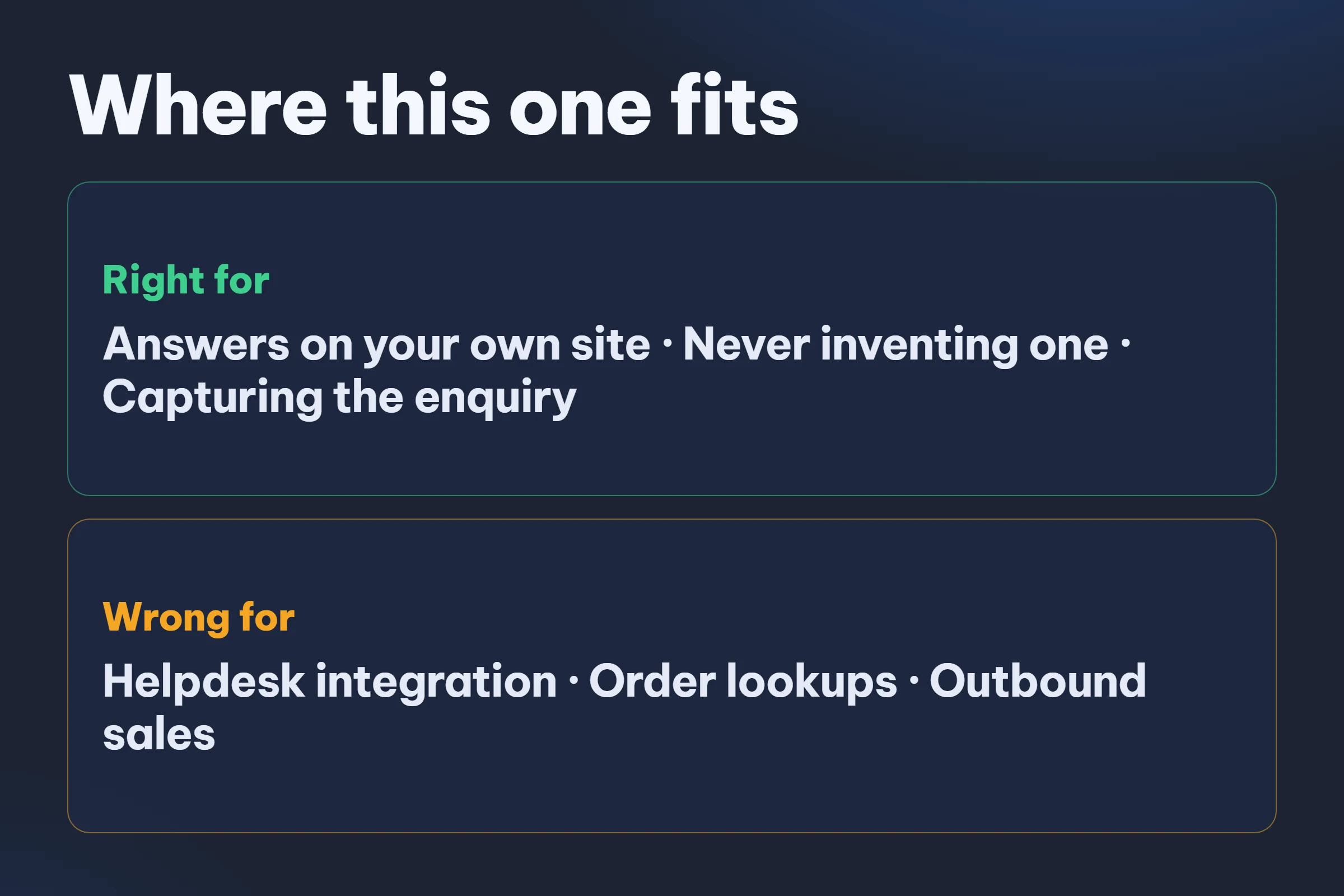
Sublex Chat answers from a business's own material and nothing else. That single rule decides everything it is good at and everything it is not.
It fits a small business whose answers are already on its website, that wants those questions handled at any hour without a person, that cares more about never inventing an answer than about handling everything, and that wants the enquiry captured when the assistant cannot help.
It does not fit a business that needs the assistant inside an existing helpdesk, one that needs order or account lookups, one that wants an outbound sales bot that chases and qualifies, or a team that wants to design conversation flows in detail. Those are real requirements and there are products built for each of them. This is not one.
Saying that costs nothing, because the businesses in the second list would have found out in week two anyway, and a customer who leaves in week two is worse than one who never signed up.
Two things that look decisive and are not
Two questions come up in almost every comparison and neither one deserves the weight it gets.
Which model is behind it. Buyers ask this a lot, and the honest answer is that it matters far less than the rule the product applies. An assistant given the wrong passage from your website will produce a confident wrong answer on any model, because the model is doing what it was asked with what it was handed. An assistant that is forbidden from answering beyond its material behaves well even on a modest model. Retrieval and the refusal rule decide quality; the model decides how nicely the sentence reads. If a product leads with which model it uses rather than what it does when it has nothing to say, that is a signal about where its attention went.
The length of the integration list. A hundred and forty integrations is a good sign about a company's age and a poor guide to your outcome. What matters is whether the two or three you will actually use are there and work properly. Check those specifically, and ignore the rest of the list, which exists to win comparison tables.
A third one worth naming: response speed. It is easy to measure, it feels important in a demonstration, and the difference between one second and three seconds does not decide anything for a visitor who was going to wait until morning for an email. Accuracy is worth waiting three seconds for.
The test that sorts all of them
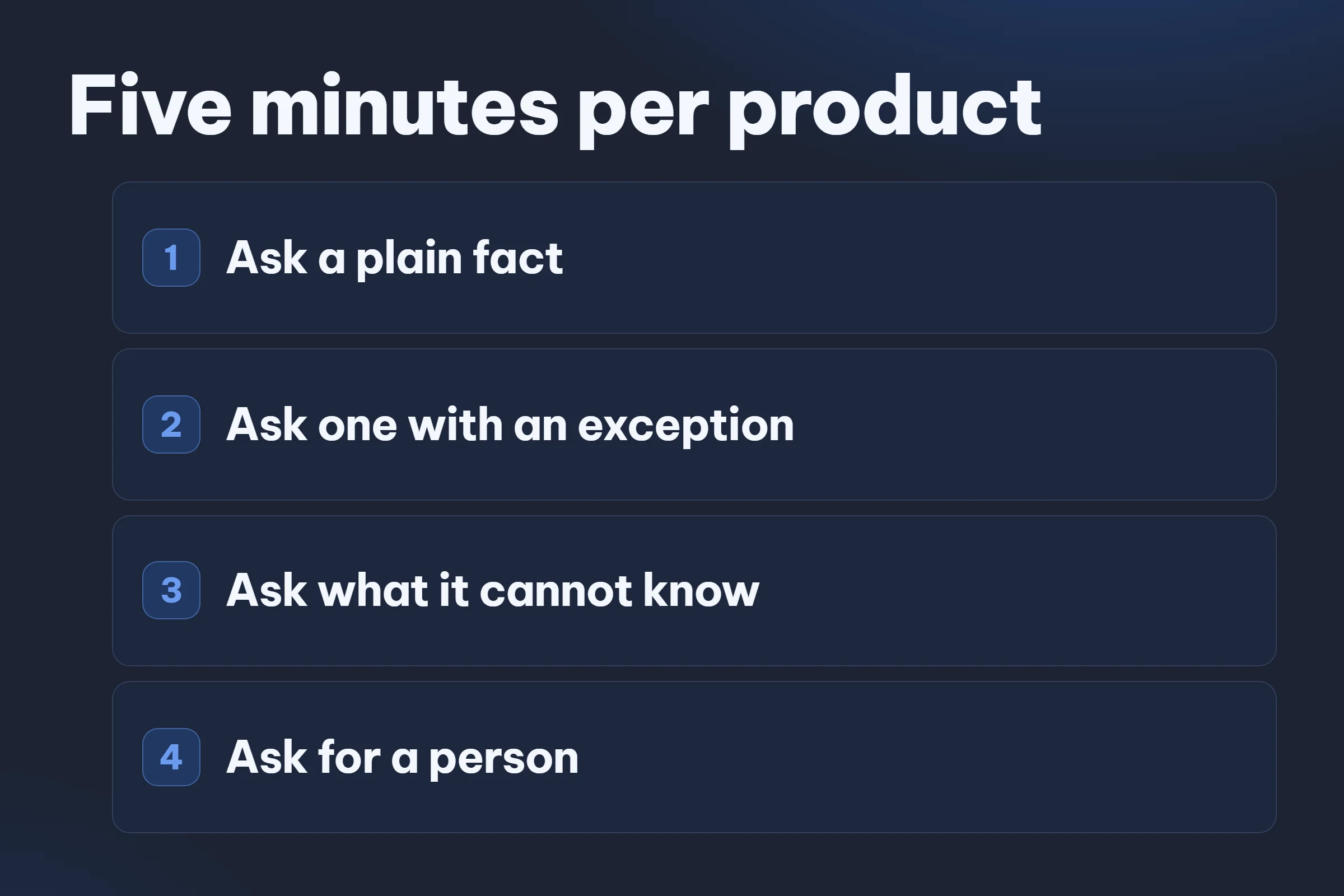
Whatever shortlist the four questions leave you with, the same test separates them, and it takes five minutes per product.
Ask a plain fact. Everything passes. This proves only that it read something.
Ask a fact with an exception in it. Something where the true answer is "most, but not all". Watch whether it notices the exception or smooths over it, because smoothing is what a model does when it is optimising for a sentence that sounds right.
Ask something the material does not contain. The right answer is a plain admission and an offer to take your details. Any plausible sentence here is a disqualification, not a quirk.
Ask for a person. See how long it takes, whether it actually does anything, and whether what it does is visible to you afterwards.
A product that passes the last two is worth trialling. One that fails either is not, regardless of how it compares on features, and no amount of price advantage makes up for an assistant that invents a refund policy at two in the morning.
Frequently asked questions
What is the best AI chatbot for a small business? The one that matches where your answers already live. For most small businesses that means an assistant that reads the public website and declines everything it was not given, because that is where the answers are and that is the failure mode that costs money.
Is a more expensive AI chatbot better? Not reliably. Price in this category mostly tracks the billing model and the size of the company selling it rather than answer quality. The four billing models produce very different bills for identical usage, so compare the unit before the number.
Should I pick the one with the most features? Features you do not use still cost you, in setup, in the training somebody needs, and in the maintenance nobody has time for. For a business without a person owning the tool, the shorter feature list is usually the better outcome.
Can one chatbot do support and sales? Technically yes, and it will do both indifferently. The two jobs pull in opposite directions: support should be brief, accurate and quick to hand over, while sales should keep the conversation going. Pick which one matters more.
How do I test one properly before buying? On your own website, with your own pages, for a month, on a free plan if there is one. A vendor demonstration answers questions the vendor chose. Your own site with your own customers tells you how often it declines and what your visitors actually ask.
What if none of them fit? Then the answer is probably that your answers are not written down yet, which no product solves. Writing them is worth doing anyway, and it makes every option on this page work better.
Where to start
Answer the four questions on paper before you open a single pricing page. In most cases they eliminate everything except one category, and choosing within a category is a much smaller decision than choosing across all of them.
Then run the four-question test on whatever survives. There is a working assistant to practise the test on, and a free plan if you would rather run it on your own site.
See Sublex Chat answer from your own website
Give your web address and watch it read your pages, then answer questions about your business. No account needed.